
lineages of valor-Dr Hamid Hussain
July 6, 2012
Dear All;
As promised, another exciting tale of a family's connection with Guides and 'rest of the story' about Ajab Khan episode (some folks interested in history had sent me few pieces about Ajab episode that were full of factual errors. I call this 'Nasim Hijazi Syndrome' where historical events are mixed with fantasies and folklore and repackaged as authentic history).
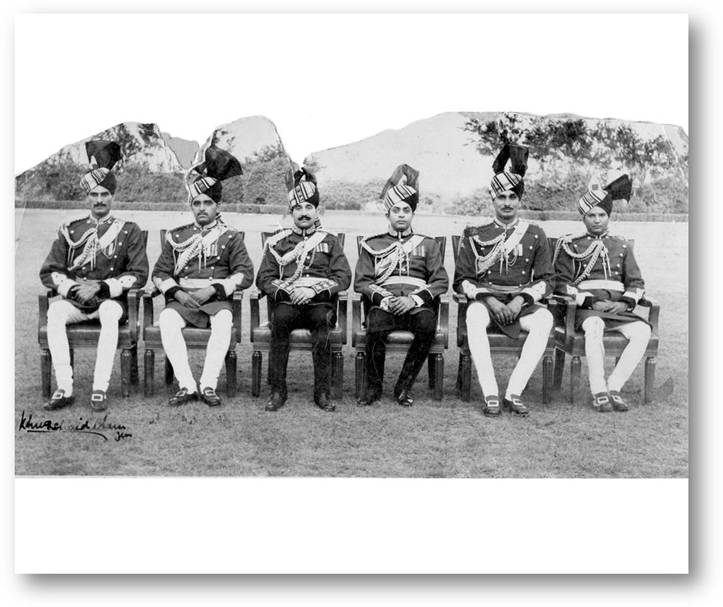
p.s. Can anyone identify that legendry Risaldar Major Asghar Ali of GGBG is present in first picture? I have heard that he was a great polo player. Â
Regards,
Hamid
Â
Lineages of Valor- Major General ® Jahanzeb Khan
Hamid Hussain
Â


|
 Governor General's Bodyguards (GGB), early 1950s. Major Jahanzeb Khan (Commandant) and Captain Khawaja Hassan Askari (Adjutant) (Picture courtesy of son of Major Hassan Askari)Â Â Â
 Â
Â
Â

|

1961 – Front Row (L to R): Brigadier Sardar Hissam El Effendi, Lieutenant Colonel Jahanzeb Khan, Major Hamid Ali Noon, HRH Prince Philip, Her Majesty Queen Elizabeth II, Brigadier Gul Mawaz, Brigadier "Hesky" Baig, Colonel "Sikku" Baig, Colonel Shaikh and Colonel Umar Khan. Back Row: Nawab Amir M. Khan (Governor West Pakistan), General M. Musa (C-in-C Pakistan Army), unidentified guest and Lieutenant General ® Yusuf Khan Afridi (Joe) (Picture courtesy of Lahore Polo Club)   Â
 |

1959. Standing (L to R): Brigadier Hissam Effendi, Lt. Colonel Jahanzeb Khan, Brigadier Sahabzada Yaqub Khan, Shah of Iran, Queen Farah Deeba, President Ayub Khan, C-in-C Musa Khan, Brigadier Gul Mawaz and Colonel Sikku Beg. (Picture courtesy of Lahore Polo Club)
Major General ® Jahanzeb Khan had four generations connection with 10th Guides Cavalry. He was from the Kuki Khel clan of Afridis of Khyber Agency. His grandfather joined the legendry Guides. His father Risaldar Moghal Baz Khan followed his father's footsteps in Guides and retired after long service and earning Indian Distinguished Service Medal (IDSM). In 1923, he was serving as Special Assistant to Chief Commissioner of North West Frontier Province, Sir John Loader Maffey. In April 1923, an outlaw Ajab Khan abducted seventeen year old Mollie Ellis from Kohat cantonment. During this crisis of the Raj, Risaldar ® Moghal Baz along with several others including Assistant Political Officer of Kurram agency Khan Bhadar Quli Khan, retired Subedar Major Azimullah Khan Afridi of Tirah valley and Malik Khan Zaman Afridi of Khyber negotiated the release of Mollie Ellis. In 1932, Moghal Baz was awarded OBE when he was serving as Assistant Political Officer of Khyber agency.
Jahanzeb was educated at Bishop Cotton School at Simla. He was one the three Indian captains of the houses. He joined Guides cavalry after commission. He became the first Indian officer to be posted to Viceroy's Body Guards (VBG). In 1950s, he commanded Governor General's Body Guards (GGBG). Later, he commanded Guides Cavalry in early 1960s. He was a good polo player. In 1962, Kharian Polo team consisting of Major General Sahabzada Yaqub Khan, Brigadier Masood Ali Baig (nick named Hesky Baig of 5th Probyn's Horse), Brigadier Hissam Effendi, Colonel Sikandar Ali Baig (nick named Sikku Baig) and Lt. Colonel Jahanzeb Khan beat visiting U.S. army polo team. His two sons also joined Guides Cavalry. Kamal Zeb retired as Brigadier and Nadir Zeb is a Major General. Nadir did some heavy lifting as Inspector General of Frontier Corps (IGFC). He was recently injured during crash landing of his helicopter. Four generations proudly served with legendry Guides.Â
Â
In Pushtu folk lore, Ajab Khan became a hero and tales of his bravery made rounds in the evening gatherings at hujras. He was labeled ghazi (victorious religious warrior) by some and later his son took the additional sir name of ghazizoy (son of a ghazi). In post-independence period, the story of Ajab Khan has been given a new twist portraying him as some kind of a national hero. Ajab was son of Sherdil and belonged to Bosti Khel section of Galai Khel sub clan of Adam Khel clan of Afridi tribe of Kohat Pass. He was a criminal outlaw involved in robberies. He was part of a criminal gang that included his brother Shahzada. On November 15, 1920, Assistant Director Medical Services of Kohat district Lieutenant Colonel Thomas Howard Foulkes was killed at his house by a gang of raiders during robbery. His wife injured in the incident died three weeks later. In February 1923, forty six rifles were stolen from Kohat police lines. A Frontier Constabulary party raided the village of Ajab Khan and recovered rifles from his house. Some articles belonging to Colonel Foulkes were also found that implicated Ajab in the murder. Ajab was not home and fled to the territory of Tirah and took refuge with Sultan Mir; a Jowaki Afridi. It was suspected that Sultan Mir was the leader of the gang that killed Colonel Foulkes. The only logical connection is that on their way to Tirah, the gang may have spent some time with Ajab and shared with him some of the loot. Some of these articles were later found in Ajab's house.Â
On the night of April 13, Ajab along with some accomplices entered the house of Major Archibald Jenner Ellis. Major Ellis was from 1 Border Regiment and he had won DSO in First World War. He was not at home that night and in the ensuing struggle Shahzada stabbed to death Ellis's wife Ellen Mary and the gang abducted seventeen year old Mollie Ellis. The gang travelled by night avoiding all contact and ended up in Khanki Bazaar in Tirah on April 19.Â
When the sun rose, Raj's administrative machinery was fully operational. Chief Commissioner Sir John Maffey took charge and Deputy Commissioner of Kohat Colonel Charles Edward Bruce (served with 24th Baluchistan Infantry before joining Indian Political Service), Political Agent of Khyber Major Herbert Cobb Finnis (originally of 14th Sikhs and killed by Waziri raiders in November 1923 while serving as Political Agent Zhob) and Political Agent of Kurram Major Heale pulled all levers of power at their disposal. Orakzai and Afridi jirgas were summoned and sent in all directions. First objective was to prevent Ajab from taking his hostage to Afghanistan.Â
Massey's own intelligence was superb and while Afridi and Orakzai tribal elders had no clue but government had already suspected that Mollie Ellis was in Khanki Bazaar in Tirah valley. Assistant Political Officer of Kurram Khan Bhadar Quli Khan travelling with his servant landed in Khanki Bazaar a day after the gang arrived there. A second team consisting of a medical missionary and matron of Peshawar church mission, Mrs. Lillian Starr and Risaldar ® Moghal Baz Khan as head of an armed escort of forty Afridis also reached Khanki Bazaar. Third team of Afridis was led by a Khyber Malik Khan Zaman Khan. During negotiations, Mollie Ellis had been transferred to Mullah Mahmud Akhundzada's house. During a heated debate, Ajab and Shahzada threatened to kill Ellis and Starr. Mullah was outraged at the behavior of two brothers and started cursing them. This created the environment for the release of Mollie. The rescuers along with Mollie retraced their steps back quickly and reached Fort Shinawari on April 24. Later, Quli Khan and Moghal Baz were awarded Kaiser-i-Hind medals (a civilian award for distinguished service) for their services in this affair.
Mrs. Starr was herself a legend and nick named Sitara (star) by locals for her devotion and incredible medical work as nursing sister. Her father Reverend Thomas Wade started medical missionary work in Peshawar in 1863. She came to Peshawar in 1913 working as nurse at mission hospital, fell in love with Dr. Vernon Starr; head of Peshawar Church mission hospital and they married in 1915. One night in March 1917, two Pathans knocked at Dr. Starr's door asking him to come with them to help a patient. When Starr opened the door they stabbed him to death. Despite this personal tragedy, Mrs. Starr came back to Peshawar in 1920 to continue her work helping the needy. Later, she married Colonel Guilford Underhill of 1/1 Punjab Regiment. Peshawar Church Mission has a connection with Guides. Lieutenant Harry 'Joe' Lumsden raised Corps of Guides at Peshawar in 1847 and their mess was on the grounds where Church Mission was later established. Later, Guides made Mardan their permanent home.Â
Afridi and Orakzai tribes had enough troubles due to this affair and they pledged not to give shelter to Ajab. Tribesmen were in general incensed about abduction of a woman against all tribal norms and Ajab and his gang had not many sympathizers. Ajab spent some time at Chamarkand in Bajawar with remnants of the Indians involved in activities against British government. This was a diverse group consisting of Muslims, Hindus and Sikhs using a mix of religious, nationalist and Communist doctrines in their struggle against British. He then went to Mandatai in Nangarhar province of Afghanistan that created problems for Afghan government. Ajab was not a happy man as he had not been able to get amnesty. Wanted by British government and abandoned by his own tribe, he was ensured a life of exile. He joined two other outlaws Daud Shah and Ardali who were accused of murder of two British officers Major Anderson and Major Orr on April 08, 1923 near Landi Kotal. In November 1923, Captain Watts of Kurram Militia and his wife were killed in Parachinar and Ajab's hand was suspected in these murders. British increased pressure on Afghan government and in January 1924, Afghan soldiers went after the gang along with pressure by Afridi lashkar on British side. Ardali was shot dead by Afghans and to avoid further complications Ajab was deported to northern Afghanistan well away from the border with India. He died in Afghanistan in 1950s.
There have been several explanations given about why Ajab decided to abduct an Englishwoman. There are many oral traditions regarding this episode. One narrative suggests that during search of the village, female quarters of Ajab family were searched and this was considered an insult to the honor and Ajab abducted an Englishwoman as an act of revenge. Another oral tradition suggests that village women scorned Ajab for his mischief that brought soldiers to their village and violated the tribal purda (curtain). Another narrative suggests that when the constabulary arrived at the village, Ajab made his escape by wearing burqa (female covering). He was ridiculed by the village women and he swore to remove this shame by doing a dare devil deed that no one had attempted before. I have another theory about Ajab's decision. Government was negotiating with Jowaki Afridis and a jirga was supposed to come to Peshawar on April 17 to finalize the deal that included the decision about Foulkes murder. Ajab was from the different branch of the tribe that was not involved in the negotiations meaning that Ajab had no representative at the table. Ajab now implicated in the murder of an Englishman feared that a government-Jowaki deal would leave him out of any amnesty deal thus ensuring a life of exile. He decided to have his own bargain chip in the form of a hostage to get amnesty of his previous crimes. In fact, later Ajab's three demands included complete amnesty, 50'000 Rupees ransom and release of four accomplices arrested after the rifles theft. Later, in his own letters to Chief Commissioner, Ajab justified his act as revenge against raid on his village by Frontier Constabulary which he considered a violation of independence of tribal areas.
It is not clear what government had agreed to during the negotiations for Mollie's release. We know that four accomplices of Ajab in jail were released. Ajab later threatened Quli Khan which raises the question whether government had agreed to some other demands such as amnesty that was not fulfilled. Moghal Baz was a Kuki Khel from Khyber agency but later settled in Mardan. Many tribesmen in government service were granted land in a settled district and this may have been the case with Moghal Baz. However, an intriguing oral story about Moghal Baz gives it a new twist. According to this story, during frantic search for Mollie, one young nephew of Ajab was arrested and later hanged. Kuki Khel tribe was furious at this gross violation by the government. Moghal Baz was a negotiator from the government side therefore they banished him from his village.Â
Ajab's son Nek Muhammad Ghazizoy was alive in Peshawar until about a decade ago. Several years ago, in Southern California I used to get fresh fruits from a shop. This was the only shop where you could get sweet small Afghan grapes and Afghan melons. Two Afghan brothers were running the shop and when I chatted with them, I found that they were Pushtu speaking. They revealed to me that they were grandsons of Ajab Khan and had left Afghanistan in 1980s. The sixty year journey of a family from Bosti Khel in Kohat Pass to Afghanistan, back to Peshawar and then all the way to Southern California had a long and interesting background more fit for an amazing piece of fiction rather than a real life experience.
Acknowledgement: Author thanks many for their valuable input and corrections.
Hamid Hussain
July 4, 2012
Â
PUBLICATIONS , RECOMMENDATIONS AND TESTIMONIALS AGHA H AMIN
http://www.scribd.com/doc/92399986/Testimonials-Recommendations-and-Publications
http://www.scribd.com/doc/83916444/Agha-H-Amin-Publications
BRIEF HISTORY OF PAVO 11 CAVALRY
http://indopakmilitaryhistory.blogspot.com/2011/09/pavo-11-cavalry.html
PUBLICATIONS AGHA H AMIN
http://www.scribd.com/doc/61839666/Indo-Pak-Wars-A-Pictorial-History
http://www.scribd.com/doc/22457862/Military-Decision-making-and-leadership
http://www.scribd.com/doc/22455178/Letters-to-Command-and-Staff-College-Quetta-Citadel-Journal
http://www.scribd.com/doc/23150027/Pakistan-Army-through-eyes-of-Pakistani-Generals
http://www.scribd.com/doc/23701412/War-of-Independence-of-1857
http://www.scribd.com/doc/22107238/HISTORY
Â
Â
Â


