
Major General Akhtar Hussain Malik-Major General Yahya Khan-Operation Grand Slam—1965
Posted by Author on
in
Blog
08
49
Major General Akhtar Hussain Malik-Major General Yahya Khan-Operation Grand Slam—1965
A


A.H Amin
September 2000
Defence Journal
INTRODUCTION
The aim of this article is to discuss “Operation Grand Slam†in the overall context of the 1965 War, assessing its strategic significance, and the various controversies surrounding it.
The Kashmir problem shaped the future of Indo-Pak Sub-Continental politics from 1947 onwards and led to the militarisation of
The Poonch Valley link road connecting Jammu with Poonch Valley, the second largest valley of Kashmir, was a hot favourite military objective of military planners in Pakistan, right from 1947-48.
One of the major military objectives of the 1947-48 War was to harass Indian communications around Jammu in areas Akhnur and Kathua.1Â
Beri Pattan Bridge over River Tawi a few miles south-east of Nowshera on this road was the main objective of a planned Pakistani armoured brigade and infantry brigade attack code named “Operation Venus†in December 1948.2Â
As a matter of fact one of the reasons which motivated the Indian Government, in 1948, into requesting for a complete ceasefire may have been its anxiety to avoid a major battle, opposite its communications to the Poonch Valley.3
The Pakistani governments, calling off the projected “Operation Venusâ€, and acceptance of this ceasefire offer and final ceasefire with effect from night 31 December 1948 and 1st January 1949, was later much criticised in Pakistan. Claims were made that the Pakistani Government agreed to a ceasefire “to the army’s horror†at a time when military victory was within
A Pakistani officer who was then commanding the infantry brigade strike force tasked to execute “Operation Venusâ€, much later in 1976 claimed that, had the operation been launched, he could have been in
Thus when “Operation Grand Slam†was conceived and launched in 1965 history was repeating itself and as later events turned out, ironically history repeated itself, in terms of irresolution and indecisiveness on part of Pakistan’s highest military and political leadership.
The bluff self-promoted Field Marshal from a so-called martial area proved himself as indecisive as the Hindustani Muslim Prime Minister of 1948 who was much criticised by many intellectuals in Pakistan6 for indecisiveness and timidity in the 1947-48 War.Â
History repeated itself for the second time in 1999 when a smaller scale military operation was called off in Kargil.
The man accused of timidity on this occasion was a Punjabi (Kashmiri) Prime Minister!Â
The 35th anniversary of the 1965 War demands that we in the Indo-Pak Sub-Continent must re-assess the validity of the historical life scripts into which past experiences have programmed us! It is a vain hope since most human beings despite all advancement in civilisation are dominated by absurd urges!
OPERATION GRAND SLAM
Background
1965 was an eventful year in Indo-Pak history. The Pakistani military ruler Ayub emerged victorious in the Presidential elections held in January 1965 amidst allegations of rigging.
This factor created a desire in Ayub to improve his political image by a limited gain in the realm of foreign relations. He got an opportunity to do so in April 1965 over a minor border dispute with
The Pakistan Army dominated the skirmishes in the Rann area as a result of which a climate of overconfidence was created in the Pakistani military and political establishment.7
In May 1965 following the jubilation in
Ayub went to Murree on 13 May 1965 to attend a briefing on the conduct of Operation Gibraltar.8Â
We will not go into the controversy surrounding this plan, which is basically an exercise in futility, and mud slinging initiated by some self-styled experts, motivated largely by personal rivalry and ulterior biases, since the prime aim of this article is to discuss the military significance of Operation Grand Slam and its connection with “Operation Gibraltarâ€.Â
In this briefing Ayub “examined†the “Operation Gibraltar†plan prepared by Major General Akhtar Malik, the General Officer Commanding (GOC) 12 Division.
The 12 Division was responsible for the defence of the entire border of
This attack was codenamed “Operation Grand Slamâ€.
General Musa, the then C in C Army and Altaf Gauhar the then Information Secretary and Ayub’s close confidant, the two principal defenders of Ayub have not given any explanation about what exactly was the strategic rationale of “Grand Slam†and what was its proposed timing in relation to “Operation Gibraltarâ€.Â
We will discuss this aspect in detail in the last portion of this article.
OPERATION “
The confusion in history writing in
It appears that the idea of launching a guerrilla war in Indian held
 Mitha claims that from 1958 to 1961 he had advised that “such operations had no chance of success and each time F.M Ayub Khan had agreed with me and vetoed the suggestionsâ€.12
General Gul Hassan states that the secret “Kashmir Cell†formed by the Foreign Office on Ayub’s orders consisting of various key officials including the DMO i.e Gul Hassan was informed by the Foreign Secretary Aziz Ahmad that the President had ordered GHQ to prepare two plans to encourage/provide all out support sabotage/guerrilla operations in Indian Held Kashmir.Â
Gul states that the decision to mount guerrilla operations with active Pakistan Army involvement was taken after the Rann of Katch skirmish.
Altaf Gauhar who was the Information Secretary at that time claims that the Foreign Secretary Aziz Ahmad had “convinced himself that Pakistan was in a position to dislodge the Indians from Kashmir†and that “Once trained Pakistani soldiers went inside Kashmir the people of the Valley would spontaneously rise in revolt†and that “fear of China would prevent the Indians from provoking an all out war that would give
Gauhar further claimed that the Inter Services Intelligence (ISI) Directorate and the Foreign Office drew up the plan for Operation Gibraltar.13
Pakistani expectations, and this does not include Bhutto alone, as many self-styled experts based on personal rivalry would much later claim; were raised to unrealistic heights after the Rann affair and Ayub was convinced that
In a written communication before the war Ayub asserted that “As a general rule Hindu morale would not stand more than a couple of blows delivered at the right time and place. Such opportunities should, therefore, be sought and exploitedâ€.14
Gauhar states that Mr Z.A Bhutto the Foreign Minister was so convincingly persuasive in his advocacy of Operation Gibraltar that he convinced many Pakistan Army officers serving in the GHQ, who in turn urged the Pakistani C in C Musa to “bite the bulletâ€.15 Further Musa, the C in C much later in 1983 claimed that Bhutto had “Brainwashed†his officers.16
These two assertions if true means that either Bhutto was a military genius or those army officers who he convinced had no grey matter and that the Pakistani C in C was a glorified headclerk whose function was that of a rubber stamp rather than anything to do with higher military strategy or operational planning.
This article is not about “Operation Gibraltar†but “Grand Slamâ€, however, no discussion or analysis of Grand Slam is possible if Gibraltar is not discussed, although in brief. Operation
The total strength of the “Gibraltar Force†was not more than 5,000 to 7,000 men subdivided into five forces i.eÂ
(1) “Salahuddin Force†operating in Srinagar Valley,Â
(2) “Ghaznavi Force “ in Mendhar-Rajauri area,Â
(3) “Tariq Force†in Dras-Kargil area,Â
(4) “Babar Force “in Nowshera-Sundarbani area,Â
(5) “Qasim Force†in Bandipura-Sonarwain area,Â
(6) “Khalid Force†in Qazinag-Naugam area,Â
(7) “Nusrat Force†in Tithwal-Tangdhar area,Â
(8) “Sikandar Force†in Gurais area andÂ
(9) “Khilji Force†in Kel-Minimarg area.18
The mission assigned to the various Gibraltar forces was warfare in the enemy’s rear including harassing enemy communications, destruction of bridges, logistic installations, headquarters with a view to create conditions of an “armed insurrection†in Kashmir finally leading to a national uprising against Indian rule leading to liberation of Kashmir or at least parts of it.19
The infiltration operation of the Gibraltar Force commenced from first week of August 1965.20Â
General Harbaksh Singh the C in C Indian Western Command described the infiltration operation as “brilliant in conceptionâ€.21Â
The Gibraltar Forces mission was too ambitious and its achievement was beyond its means, however, in words of Indian military writer Major K.C Praval “Although the Gibraltar Force failed to raise a revolt, they did succeed in creating a great deal of confusion and disorder by acts of sabotage, violence and murderâ€.22
Praval praised “Nusrat Force†which was operating in Tithwal area which in his words “caused a great deal of damage before it could be pushed back over the ceasefire lineâ€.23 Indian General Harbaksh Singh in the typical Indo-Pak style of not being intellectually honest once dealing with assessment of enemy actions, inadvertently admitted the mental dislocation that the Gibraltar Force had caused in the headquarters of Indian 15 Corps.
Harbaksh thus stated “General Officer Commanding 15 Corps gave the following assessment of the prevailing situation: — The maximum success gained by the infiltrators was in the Mandi area where they had secured local supportâ€24 .......... “General Officer Commanding 15 Corps in a personal signal to me recommended the abandonment of the Hajipir offensive .....on account of the serious tactical situation in that sectorâ€. 25
 This happened on 15th August! On 17th August 1965 General Harbaksh Singh noted that the 15 Indian Corps Commander’s assessment of operational situation in Kashmir was “rather too grim and gloomyâ€.26Â
Even Joginder Singh who later wrote a book to refute most of Harbaksh’s assertions admitted in his book that “GOC XV Corps Lt Gen Katoch appeared to be overwhelmed by the scale of infiltrationâ€.27
The reader may note that all this was happening despite an overwhelming Indian numerical superiority in troops. A small example being the 25 Indian Division area where the Indians had some 20 infantry battalions 28 at a time when the total strength of the 12 Pakistani Division responsible for all 400 miles of
The local population of Indian Held Kashmir did not co-operate with the Gibraltar Force and by 18th August the operations of the Gibraltar Force were considerably reduced. The Indians brought in additional troops and the infiltration operation was checked by 20th August.
As discussed earlier the Indian 15 Corps Commander was unnerved, however, the C in C Western Command Harbaksh Singh exhibited greater resolution and spurred the 15 Indian Corps into launching two major counter infiltration attacks inside Pakistan Held Kashmir to destroy the logistic bases in Hajipir Bulge and
Both these attacks succeeded since the 12 Division was already over stretched with single infantry battalions holding frontages varying from 10 to 20 miles. 30Â
There is absolutely no doubt that
The loss of Hajipir Pass, the principal logistic base of the infiltrators on 28th August and Indian successes in the Neelam Valley and opposite Uri on 29-31st August 1965 unnerved the Pakistani GHQ who assumed that Muzaffarabad was about to be attacked!31
The supposed liberators of Indian Held Kashmir were more worried now about what they had held before commencement of hostilities!Â
It was under these circumstances that the Pakistani GHQ ordered execution of Grand Slam with the aim of relieving Indian pressure against Muzaffarabad!Â
Shaukat Riza the official historian of the 1965 War admitted that by 31 August the Indians had ruptured 12 Division’s defences and this was the main reason why the GHQ decided to attack Chamb “to ease pressure on 12 Divisionâ€.
Shaukat also quoted Musa and the Chief of General Staff Sher Bahadur in stating that the main reason why Grand Slam was launched was that “there was danger of Indians capturing Muzaffarabadâ€.32Â
Musa in his roundabout way of saying things did not mention Muzaffarabad but merely stated that the main object of launching “Grand Slam†was “reducing pressure in the north by capturing Chamb and threatening Akhnurâ€.33
THE
Significance of Akhnur
Akhnur Class 18 bridge 34 on the fast flowing
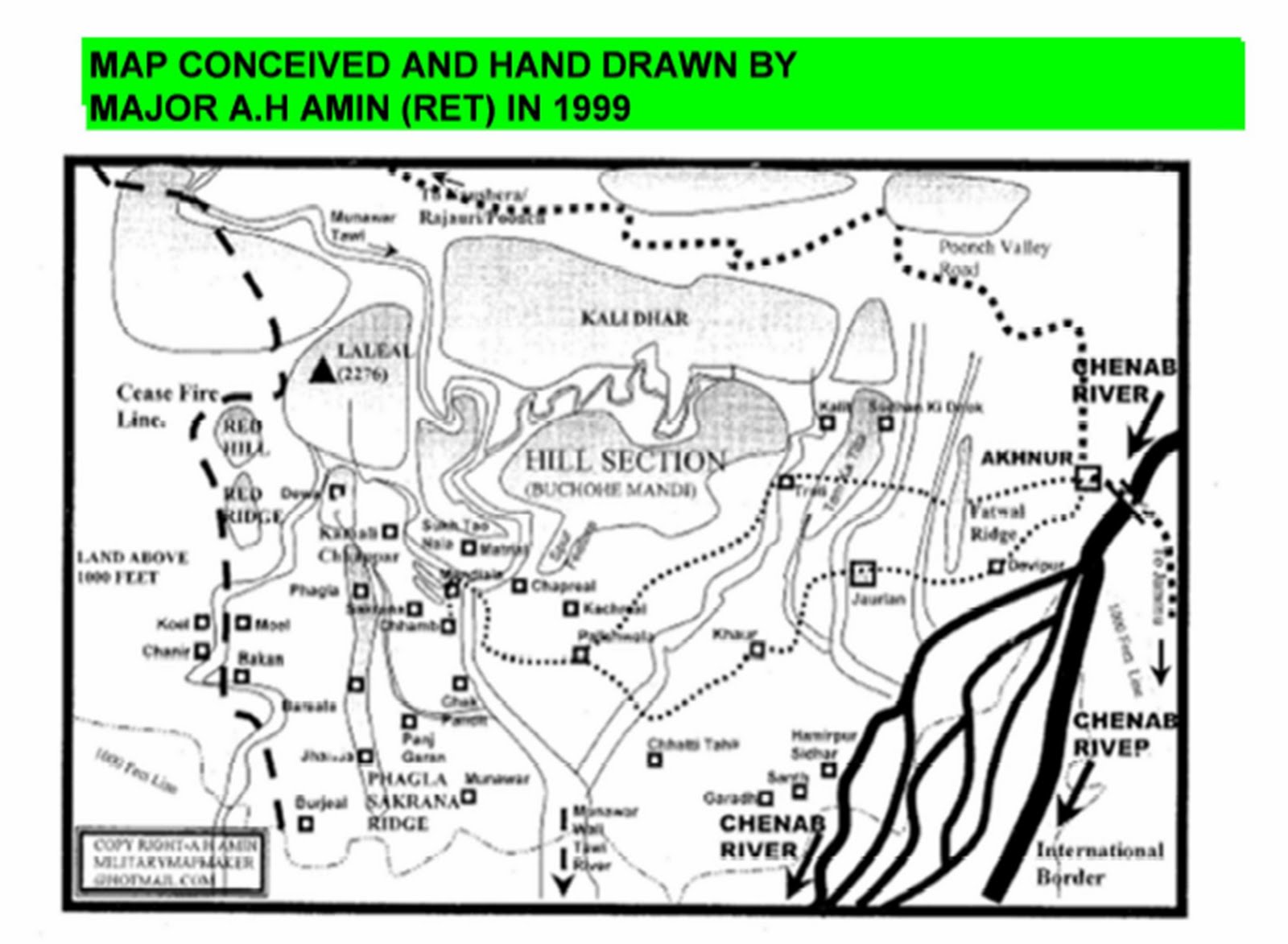
The bridge was the sole all weather lifeline of one oversized Indian infantry division, with at least twenty infantry battalions, defending Poonch, Rajauri, Jhangar and Nauhshera and one Independent Infantry Brigade defending Chamb-Dewa Sector. Possession of Akhnur could enable an attacker to threaten

Orientation with the area
Chamb-Jaurian Sector is bounded by the ceasefire line from Dewa till Burjeal in the west, the international border from Burjeal till River Chenab in the south, various branches of River Chenab from Phulkean Salient till Akhnur in the south and Southwest, and a range of hills between the height of 1000 to 3000 feet running in a roughly east-west direction in the north.
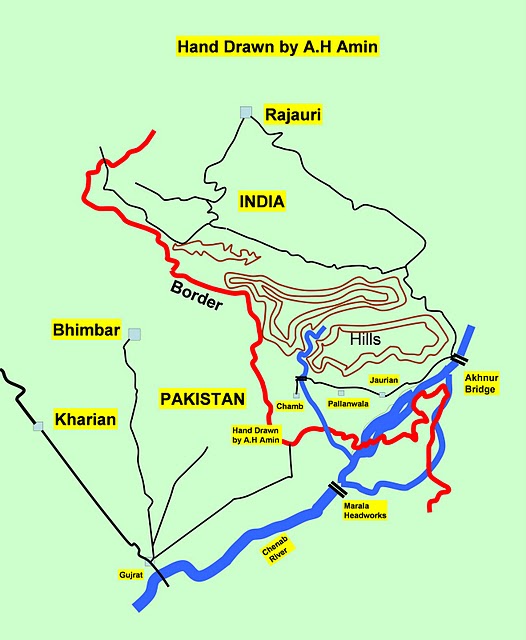
Some ridges run from this range of hills downwards in a north-south direction, most prominent of which are Phagla-Sakrana Ridge located about between a mile and two miles, eastwards from the border, followed by Tam Ka Tilla, east of Pallanwalla and the Fatwal Ridge four miles west of Akhnur. Average relative height of each ridge varied from 40 to 80 feet.

These ridges on the face value were minor features, however, in terms of fields of fire and observation; their value was immense for a defender engaged in opposing tanks. The gradient rose from north to south as well as from west to east, and the area to the north restricted tank movement, while the area in the south with minor boggy patches afforded excellent manoeuvrability for tanks.
Two small ridges known as Mandiala North and South dominated Chamb village itself. The Munawar Wali Tawi running from north to south into the Chenab River divided the sector into two halves, was located about 7 to 8 Kilometres from the border.Â
The Nala had a wide bed varying from 100 yards in the north to 300 yards in the south and steep banks, which made it a partial tank obstacle.
There were various crossing places on the Nala notably at Chamb, Mandiala, Darh and Channi from north to south respectively.Â
The Nala had a lot of water in summers but maximum water depth in September was not more than four feet, thus making it negotiable for all types of tanks.Â
Only one partially constructed bridge spanned the Nala near Chamb in 1965. Road Akhnur-Jaurian Chamb to the south and Road Akhnur-Kalit-Mandiala, both running in a east-west general alignment were two metalled roads running almost parallel to each other connected Chamb with Akhnur.
The area of manoeuvre for tanks from the west was restricted to a 12 Kilometre gap between Burjeal and Dewa Hills and a kilometre tract from Burjeal to the
Both the roads leading from Chamb to Akhnur were intersected by Nalas running from north to south at a distance of two to four kilometres with small ridges in between, thus reducing tank speed, but were no obstacle for tanks.
The ground all along was thus broken as well as interspersed with dry Nalas. These Nalas restricted the cross-country mobility of wheeled vehicles once off road.Â
There were mango groves and wild orchards at places, which provided adequate cover. The area was well cultivated and in September 1965 the fields had four feet high standing crops of millet and maize.Â
River Chenab running from north-east to south west in the south and the line of hills running in an east-west direction provided natural built-in flank protection against any tank threat, for any tank force advancing from west to east but also restricted the movement of a tank force.
In terms of tank manoeuvrability and space for manoeuvre the area from the border in the west till Akhnur may be described as a cylinder which is about 12 kilometres wide on the extreme western side at its western entrance and gets progressively narrower as one advances from west of east by virtue of a line of hills in the north and Chenab River in the south both of which successively get progressively closer narrowing the north-south space reducing the north south open space gap from 12 kilometre in the west to about 3 to 4 kilometre at Akhnur.
Thus in terms of tank warfare, the defenders task became easier, as the attacker advanced from west to east since space for manoeuvre was reduced by some one fourth.35
Indian and Pakistani Force Composition and Plans
Indian Force Composition and Plans. Till August 1965 the Indian force defending Chamb Jaurian consisted of the 191 Independent Infantry Brigade Group consisting of four infantry battalions and no armour.36Â
In addition the border posts were manned by two irregular battalions of Punjab Armed Police and
In May 1965 as part of “Operation Ablaze†(Indian plan of mobilisation/shifting forward of forces in Punjab in May 1965) the Indians placed a tank squadron of AMX-13 Light tanks under command 191 Brigade.37Â
Activities of the Gibraltar Force Infiltrators in Chamb-Jaurian forced the Indians to bring in two additional infantry battalions by end of August 1965, 38 however, both infantry battalions reverted to their parent formations after successfully dealing with the Gibraltar Force infiltrators by end of August.39Â
In 1956, 80 Indian Infantry Brigade responsible for defence of area Naushahra-Rajauri-Jhangar had pointed out that 191 Brigade defending Chamb-Jaurian Sector to his left constituted a vulnerable left flank.40
The same officer as Brigadier General Staff 15 Indian Corps Kashmir had concluded that Pakistani troops attacking from opposite Chamb could capture Chamb and had recommended stationing of a tank regiment in the sector, upgrading 191 Infantry Brigade to a division and construction of an alternate bridge over the Chenab at Riasi.41
None of these recommendations except upgradation of
The Indian military planners till 1965 had firmly believed that Pakistan would not cross the international border between Chenab and Burjeal and thus regarded the southern half of Chamb Salient as “sacrosanctâ€.42
The Indian planners had hypothesised that the most likely area of Pakistani attack in South Kashmir was the Jhangar-Nowshera Sector.43Â
The Indian defences in Chamb-Jaurian were thus not as extensive as in other sectors of
The Indian artillery consisted of just one field regiment and a troop of medium guns.44 In August 1965 in the wake of Operation Gibraltar the Indian High Command finally decided to upgrade Chamb-Jaurian Sector to a divisional command, however, till 1st September 196545 the area was defended by 191 Independent Infantry Brigade directly under command 15 Indian Corps.
The 10 Division headquarters staff designated to take over the area was at this time being organised at Bangalore in the Indian south.46 The 10 Division headquarters was assigned a time frame of three weeks in August 1965 and ordered to take over the command of 80 Brigade and 191 Brigade by 15 September 1965 and had reached Akhnur by 28th August 1965.
The headquarters had no communication equipment and nominal staff on 1st September 1965.47Â
The Indian armour consisting of a squadron of AMX-13 Light tanks which was assigned the responsibility of anti tank defence of the main tank approach west of Chamb.Â
It was deployed in an extended form two troops on a ridge between Daur and Palla responsible for the defence of the area from Paur in the north till a little east of Burjeal in the south, one troop in the south in Munawar area and one troop in reserve at Barsala.Â
On 1st September, however, three tanks were under repair in the rear. All Indian infantry battalion anti-tank recoilless guns were grouped under 15 Kumaon and tasked with the anti-tank defence of the Mandiala crossing.
The border was manned by the border force irregular battalions and 3 Mahar and 6 Sikh Light Infantry as shown on the map with 15 Kumaon and 6/5 Gurkha in depth. 15 Kumaon was deployed on the pivotal
This Ridge it may be noted was an important feature which dominated both the

Pakistani Force Composition and Plans.
The division was commanded by Major General Akhtar Malik described by Shaukat Riza as a “largehearted man and a natural leaderâ€.
One whose “subordinates never felt crowded by him, or inhibited in speaking out their mindsâ€.48Â
Another military historian described Akhtar Malik as “an avid bridge playerâ€.49Â

Akhtar Malik was assigned two tank regiments (from 6 Armoured Division then deployed in Gujranwala area), an independent artillery brigade (Artillery 4 Corps) consisting of three medium regiments, one field regiment, two heavy batteries of 155 mm guns and 8 inch guns respectively, a Light Anti-Aircraft gun battery, a corps artillery locating regiment, another artillery brigade (Artillery 7 Division) consisting of two field regiments and one locating regiment.Â
His infantry component consisted of three infantry brigades i.e Number 4 Sector (3 and a quarter infantry battalions of the semi-regular AKRF), 10 Brigade (Two regular battalions) detached from 7 Division and placed under command 12 Division for Grand Slam and his own divisions, 102 Brigade (three infantry battalions).50
Akhtar Malik moved to Kharian on 28th August with a small tactical headquarters. Arrangements were made to exercise command of the Grand Slam force through the communication system of the 4 Corps Artillery Brigade.Â
The Pakistani plan was based on three phases i.e an initial breakthrough by two infantry brigades each supported by a tank regiment along two points capturing the Chamb salient east of Tawi Nala, followed by capture of Akhnur by 10 Brigade Group (including a tank regiment) and finally a northward advance by the 102 Brigade on axis Akhnur-Jhangar linking up with Pakistan’s 25 Brigade operating against Indian communications in Naushera-Jhangar area with the final objective of capturing Rajauri51 which Pakistan had lost earlier to an Indian tank squadron on 12 April 1948.52

Comparison of Strength
It is an unfortunate trait of Indo-Pak history to magnify enemy strength and to omit mentioning own strength. The operational situation in Chamb was thus later described in words like “the Indians held the
Apart from its very strong fortifications, the Indians had by then increased their forces in Chamb to seven battalionsâ€.54
The following table comparing Indian and Pakistani strengths is self explanatory:—
                                                                                    | RATIO | REMARKS | ||
INFANTRY (Battalions) | 8.25 |  4 | 2 : 1 | Two Battalions of border police   have not been counted as these  were like the Pakistani Rangers. One Indian infantry battalion included in the total i.e the 6/5  Gurkha was deployed at Kali Dhar in the rear and had nothing to do with the fighting on 1st September 1965. |
TANKS (Squadrons) | 6 | 1 | 6:1 | Pakistani tanks were far superior to Indian tanks in terms of firepower, mobility as well as protection. |
ARTILLERY (Batteries)                                                              | 18 | 3.5 | 6:1 | The Pakistani total does not include one anti aircraft battery that enhanced air defence and two regiments of locating artillery which severely  reduced the Indian artillery’s capability to retaliate, by virtue of locating enemy guns and neutralising them by counter bombardment. Pakistani batteries included nine field batteries, seven medium batteries and two heavy batteries while Indians had three field and a troop of medium guns. |
COMMAND AND CONTROL | Ad hoc through artillery headquarters | Same since 10 Div HQ was newly raised  | 10 Div HQ was brought from |
Execution of Operation Grand Slam.
We will not discuss each and every detail of Grand Slam operations but stick to the salient facts relevant to the overall context and scope of the operation.Â
The Pakistani attack commenced at 0500 hours
The artillery was deployed so boldly that medium and 8 inch howitzers were deployed ahead of field guns 56 thus increasing their range and ability to support operations for a longer duration without redeployment.

Pakistani armour which was divided into squadrons did not do well on the 1st September and was effectively engaged by Indian anti-tank guns and AMX-13 tanks.Â
11 Cavalry was checked in the south by the two three tank troops of 20 Lancers while 13 Lancers attacking in the north was also checked by the brilliant anti-tank gun screen under 15 Kumaon and a single tank troop of 20 Lancers.

The infantry brigade commanders took greater interest in the work of battalions and the first major tactical blunder of the day was committed once the southern attacking infantry brigade i.e the 102 Brigade Commander wasted the entire day by insisting that Burjeal a minor position must be captured despite clear instructions of General Akhtar Malik to bypass it.57


 |
| Villagers inspect a captured Indian AMX 13 tank and chat with some officers  of 13 Lancers |
 Thus half of 102 Brigade and a squadron of 13 Lancers was committed to clear the
Shaukat Riza states that it was defended by two infantry companies of 6 Sikh but also adds that only 14 Indian soldiers were captured once it (Burjeal) was finally cleared!59
Shaukat’s verdict on the operations of 1st September is accurate once he states thatÂ
“The Indians had only covering troops on border outposts “but the Pakistanis failed to cross the Tawi on 1st September as their “artillery fire was distributedâ€.60
I am inclined to feel that a great opportunity to inflict a great defeat on the Indians was lost on 1st September 1965 , in the manner in which the Pa
Post a Comment