
The First Victoria Cross of British Indian Army
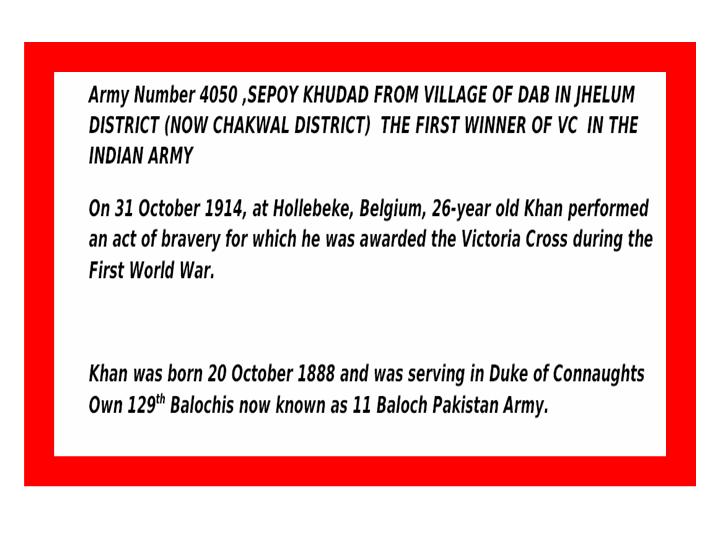
SEPOY KHUDADAD KHAN
(Indian soldiers were not eligible in the racially biased British Army from 1856 when the Victoria Cross was instituted till 1913)
(The Indian corps was taken in France out of sheer desperation because the British had no other troops .The Indians were not given any winter clothes and were rushed into the battle whereas the pampered Canadians were given six months training before being deployed in France ! As a rule British Imperial policy was against deploying Indians against the white race since it would break the myth of the white mans superiority ! Thus in Second World War Indian Army was not used in France which was a British ally and used only against the Axis countries in North Africa and Italy)
Agha H Amin
Khudadad Khan was born in the Punjab (now in Pakistan) in 1887. His family were Pathans who had moved to the Punjab from the North-West Frontier between India and Afghanistan. He joined the army as a sepoy or private soldier for the sake of regular pay and a chance of honour and glory.

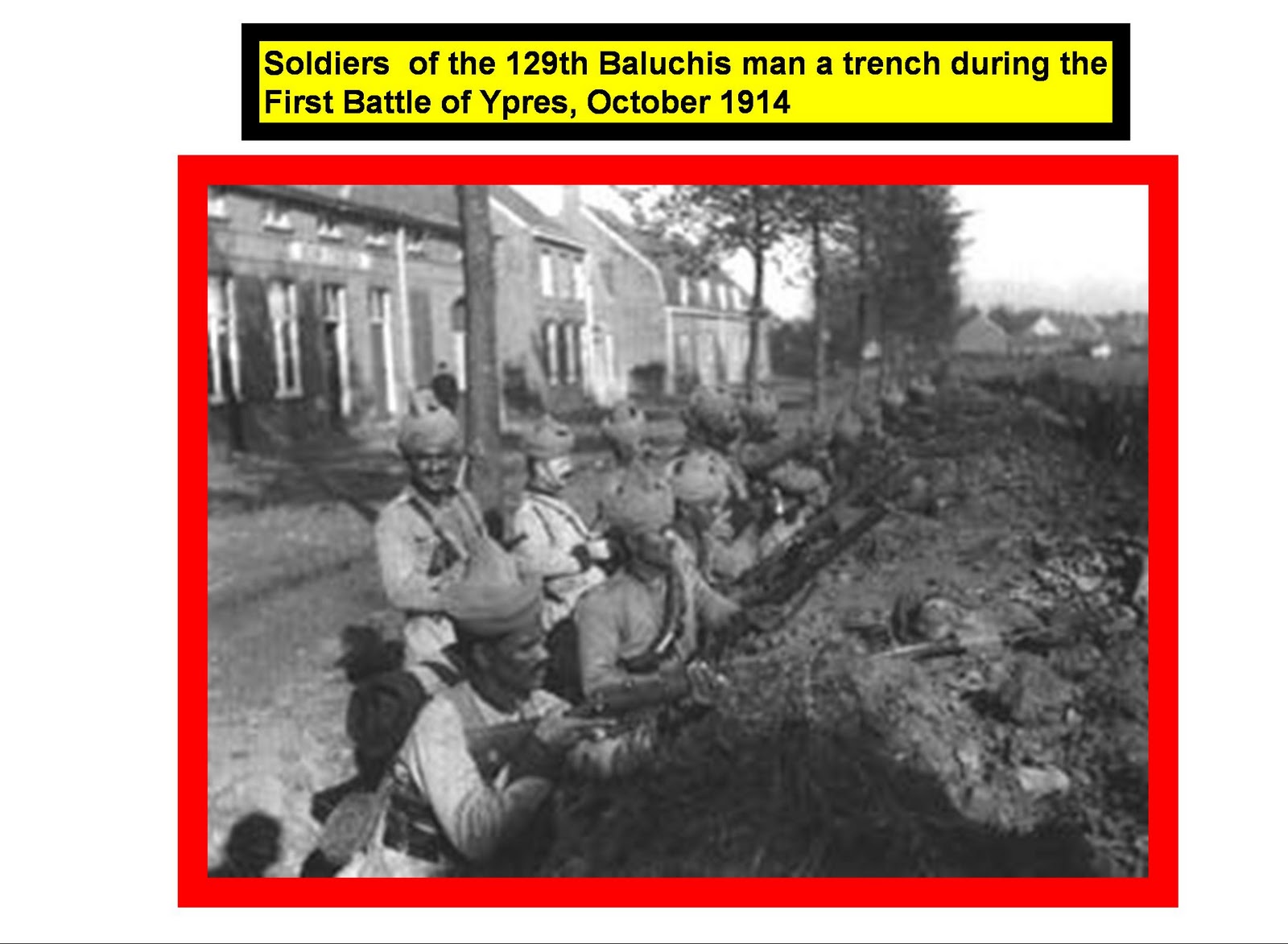
In October 1914, almost immediately after arriving in France, the 129th Baluchis were among 20,000 Indian soldiers sent to the front line. Their job was to help the exhausted and depleted soldiers of the British Expeditionary Force (BEF) to prevent the advancing Germans from capturing the vital ports of Boulogne in France and Nieuwpoort in Belgium. If the Germans could manage to take Boulogne and Nieuwpoort, they would choke off the BEF’S supplies of food and ammunition, and the Allies would lose the war.
The 129th Baluchis, with whom Khudadad Khan was serving as a machine-gunner, faced the well-equipped German army in appalling conditions - shallow waterlogged trenches in which to take cover, a lack of hand grenades and barbed wire, and a dire shortage of soldiers to man the defensive line. They were also outnumbered five to one. When the Germans attacked on 30 October, most of the Baluchis were pushed back. But Khudadad Khan’s machine-gun team, along with one other, fought on, preventing the Germans from making the final breakthrough. The other gun was disabled by a shell, and eventually Khudadad Khan’s own team was over-run. All the gunners were killed by bullets or bayonets except the badly wounded Khudadad Khan. He pretended to be dead until the attackers had gone on - then, despite his wounds, he managed to make his way back to his regiment.

Thanks to his bravery, and that of his fellow Baluchis, the Germans were held up just long enough for Indian and British reinforcements to arrive. They strengthened the line, and prevented the German army from reaching the vital ports.
Sepoy Khudadad Khan recovered from his wounds in an English hospital, and three months later was decorated by King George V at Buckingham Palace in London with the Victoria Cross, Britain’s highest award ‘For Valour’. He was the first Indian to receive the award.
POSTCARD STAMP COMMEMORATING SEPOY KHUDAD KHANS VICTORIA CROSS ISSUED BY THE MAHARANI OF BHAVNAGAR STATE IN INDIA TO SUPPORT THE GREAT WAR EFFORT FUND

Khudadad Khan returned to India, and continued to serve in the Indian Army. In 1971 he died at home in Pakistan, aged 84. Several of his descendants now live in England.


Sepy Khudadad Khan who has been decorated with the VC by the King, was under the command of Capt. R. F. Dill, a son of Rev. Marcus Dill, formerly of 1st Presbyterian Church, Ballymena. Captain Dill is also related to Sir Samuel Dill of Belfast. His name appeared among the recipients of the DSO in the New Year Honours.
Capt Robert Forster Dill, DSO was the Machine Gun Officer in 129th Duke of Connaught's Own Baluchis, 7th (Ferozepore) Brigade, 3rd (Lahore) Division. Born 6 June 1883, educated Malborough. Married Margaret Douglas on 4 September 1913 who was the only daughter of Gen. George Farquharson Pengelly, RMA, of Bembridge House, Fareham, Hampshire.
Capt Dill was killed in action at 11 p.m. on 11 April 1915 in trenches at 'B' Sub Section, Neuve Chapelle during relief by half battalion 59th Rifles and half battalion 4th Black Watch. He is now buried at Cabaret-Rouge British Cemetery, Souchez. Previously buried at Vieille Chapelle Old Military Cemetery.


