
1965 WAR -A DETAILED ANALYSIS-PART ONE
By
Major Agha.H.Amin (Retired)
1999


This is a chapter of my book The Pakistan Army since 1965 published in August 1999
CHAPTER FOURTEENÂ Â ANALYSIS -Â 1965Â WAR
Havelock said that ; "In philosophy,it is not the attainment of the goal that matters,it is the things that are met with by the way".So it is with war.The most important thing for the student of military history or the art of war is not whether a country lost or won the war but how it was fought,how units performed in action,how decisions were made in face of the stress and strain of battle,the difference between practice and precept in short all matters pertaining to strategy tactics leadership equipment etc.In other words to simply analyse the war to answer the questions like "Whence"? "Whither" ? "Why"? and "How"?In this analysis of war we have to go beyond probabilities and examine various facets of a particular situation and arrive at conclusions that will assist us in face of a similar crisis situation in future.War is the final audit of an army in which unit efficiency as well as higher and lower leadership is gauged and no book on an army is complete without analysing in detail the qualitative efficiency of an army in actual War.Unfortunately most books written on both Pakistan and Indian Armies by foreigners and therefore meekly accepted by the subcontinentals who suffer from a subtle inferiority complex;as the final authority; do not discuss the qualitative efficiency of both the Pakistan and Indian Armies in any actual war; both as British Indian Army and as two different armies after 1947!Instead these books beat round the bush discussing vague and largely irrelevant issues which their authors have decided to highlight,merely because they have decided to write a book and want to write their book without going into the subtleties of actual wars fought by the Indo Pak armies.
In the following paragraphs an attempt has been made to analyse the conduct of 1965 war and to answer certain questions about the qualitative efficiency of the Pakistan Army in a detached manner separating myth from reality and fact from fiction.This analysis is important because a considerable part of Pakistani military history has been deliberately or inadvertently distorted based on nationalistic parochial personal and inter arm prejudices and jealousies.
THE BRITISH COLONIAL LEGACY
We have already discussed in detail the impact of the British military tradition on the Judo Pak armies in our earlier chapters dealing with the armies of the English East India Company and the pre 1947 British Indian Army.This was not something confined to Judo Pak subcontinent alone but an all Asia trend.From the late eighteenth century the "European Way of Warfare" was generally borrowed and follow as the gospel truth by many East European and Afro-Asian armies.The trend of "importing the European way of war" started around 1600 when the Ottoman Turks came into contact with the European powers in Eastern Europe and Russia.Till 1500 the Europeans who had as a matter of fact military failed in the Crusades against Asia enjoyed no significant military advantage over Asia.Till the invention of gunpowder the cavalry remained the dominant arm in battle and the infantry was relegated to a secondary role.The ascendancy of European methods of warfare starts with the advent of Gustavus Adolphus(1496-1560) of Sweden who introduced a renaissance in the art of warfare by "harnessing modern technology to a practical military philosophy" .Gustavus principal contribution was the introduction of a relatively superior conceptual framework of integrating military organisation with weapons and tactics.He created an infantry organised in brigades of two to four regiments each of which had eight battalions of four companies etc.He introduced similar reforms in cavalry and artillery integrating artillery with infantry and cavalry in battle and restructured infantry formations in such a way that their firepower was enhanced.One of his most important reforms was employment of cavalry as a "shock weapon". Gustavus's methods were copied by the French and the British.Gustavus 's tactics were improved by Turrene of France and Cromwell and Marlborough of England and were further improved by Napoleon who was able to benefit from the analytical studies of great military thinkers like Gribeauval Maurice de Saxe Bourcet Joseph Du Teil and Guibert.Formal military schools were organised in France where the art of war was studied while similar institutions were founded in Prussian and Sweden.By 1600 Russia was the first country outside mainland Europe to realise that there
was something conceptually and organisationally superior in the West European way of warfare which enabled them to defeat numerically superior but more primitively organised armies.lt may be noted that as late as 1592 the Russians were no match to the Muslim Tartars of the Golden Horde who sacked Moscow in 1571 and managed to penetrate into suburbs of Moscow as late as 1592.1t may seem unbelievable to many but as late as 1660s the Crimean Muslim Tartars were one of Russia's most feared enemies2..A similar pattern of imitation was followed in the Ottoman Turk Army from approximately 1750 to 1914 when the Ottomans discovered that medieval tactics of cavalry assault were of little utility against relatively numerically superior or equal strength European armies with superior organisation'.It was adoption of superior West European military tactics which enabled the Russians to defeat the Ottomans during the period 1699-1878.A similar effort was made in the Egyptian Army of Mohammad Ali during the period I803-304.The Chinese started organising their army on European lines from approximately 1850 onwards following disastrous military performance in the Opium War of 1840-42.The Japanese learnt a similar lesson from the humbling of China by the Europeans in the Opium Wars and invited a French Military Mission in 1867 to organise and train their army in modern military methods5.
We have seen that a similar trend was followed in India when the European companies appeared on the Indian scene as major participants in the struggle for political supremacy in the period 1740-1800 in the situation created because of the vacuum which developed as a result of the decline of the Mughal Empire.The Indian native states discovered that smaller armies with a European nucleus and larger number of Indians trained in the European way of war could defeat numerically much larger armies of the Indian rulers.Thus all Indian states imitated the European companies and imported military advisors from France Italy Germany Ireland etc to train their armies on European lines.By 1849 however the English East India Company had defeated all native states employing as we have earlier discussed a largely native army led by British officers and based on a smaller European core element.From 1757 to 1947 for a period of approximately 190 years India saw an army of Indian mercenaries led by British officers which dominated India.This army was primarily an internal security army which was theoretically supposed to defend India against a possible Russian invasion from the northwest.Later as w-e saw the outbreak of first world war forced the British to employ the Indian Army as a desperate remedy against the German invasion of France.After the first world war the Indian Army was once again relegated to its major role of internal security.This was followed by the Second World War which forced the British to once again re equip and modernise the Indian Army in order to fight the second world war.This was followed by the partition when the British Indian Army was divided on religious lines and was bifurcated into two blocks of a tree whose sapling was planted by Clive in 1757.Any discussion or analysis of the performance of Pakistani or Indian Armies based on the assumption that these armies came into existence in August 1947 is meaningless and incomplete.The organisational tactical and social development of both the armies had a 190 year old connection with British rule in India and influenced their conduct in 1948 1965 1971 wars and even today in many aspects.We will therefore first of all analyse the conduct of Pakistan Army in 1965 with particular reference to the influence of the "British military Legacy".An attempt was made by sycophants in the period 1958-69 to prove that the Pakistan Army was largely the creation of Ayub Khan!There are two types of men in history;ie those who follow the status quo and those who are originators or executors of dynamic ideas which change the course of history ! Both Indian and Pakistan Armies were dominated by men of the former category.In India primacy of civilian leadership did not allow the growth of dynamism in the army while in Pakistan concentration on improving personal fortunes and in perpetuating military dictatorship ,kept the military usurpers attention fixed on non military things!In other words no major change or reform was undertaken in both the armies as far as doctrine staff procedures and military organisation were concerned .The armies which fought the 1965 war were led by men who were the products of the British Colonial heritage. We will examine the influence of British military colonial legacy on Pakistan Army's conduct in 1965 war in the following paragraphs.
British Indian Military Tradition:-Britains power was never based on its army but on its naval power and superior diplomacy which enabled it to defeat its various European mainland rivals by coalition warfare.Thus after Marlborough British Army's role in land warfare on European mainland decreased and during the Napoleonic wars Britain's main contribution consisted in naval warfare or in providing finances for sustaining the various coalitions against France than in actual war against France.Thus Napoleon was destroyed in Russia and in the campaigns of 1813 and 1814 in which the British Army had no role.Even Waterloo was a coalition affair in which the Prussians played as major a role as the British.In short the foundation of British supremacy or British power was not military excellence but other factors like naval power,super.ior diplomacy and an overall superior political system.In this sense the British legacy which the
Indo Pak armies inherited was certainly not the finest in the world.But the difference did not end here.The British Indian Army which was the father of the post 1947 Indo Pak Armies was an even more outdated organisation than the regular British Army.This was so because the regular British Army was designed to fight Britain's European enemies and thus got more attention in terms of finances equipment and was more vigorously reformed by a concerned parliament.The British Indian Army which was primarily an internal security army was far more backward than the regular British Army because it was not designed to face any European foe till 1914 except the Russians whose military potential or effectiveness was regarded as far more inferior than Britains West European rivals like Germany and France and which in any case performed very poorly in the Crimean War of 1854-56 and was later defeated by an Asiatic power in the Russo Japanese War.In terms of equipment the Indian Army as we have already seen was deliberately kept one generation behind the regular British Army whether it was infantry weapons or artillery (which was taboo for Indians except few mountain batteries in which Indians could serve as common soldiers).The Indian Army was trained as late as 1900 to fight primarily as battalions or brigades against frontier tribesmen. We have already discussed that the First World War forced the British to slightly modernise the Indian Army and the massive Indian contribution to the British war effort forced the British to grant the Indians the privilege of Regular commission in the army.The Indians selected for officer rank were from the most loyal classes with proven record of loyalty to the British Empire.Even Indianisation (introduction of Indian Army Officers) was resisted by the British Indian Army officers and as late as 1939 twenty years after Indianisation had started there were just 333 regular Indian officers in the Indian Army as against 3,031 British officers6.We have already seen that after 1918 it was felt that the Indian Army would not be required to fight in a European war and this led to massive reduction in the size and resource allocation of the Indian Army.Thus the Indian Army was so outdated in 1938 that General Auchinleck observed in 1938 that in terms of modernisation and equipment it was behind even the Iraqi Egyptian and Afghan Armies '!There was another serious misconception in many minds and has been carried forward till today that the Indian Army was the finest army in the world and played a major part in many British victories.There is no doubt that the Indian Army played a significant role in British Empires wars.However it must be remembered,as we have just discussed, that Britains wars right from the time of Marlborough were coalition wars and British Army's role in these successively became lesser and lesserin this context the Indian Army's share in the relatively limited contribution made by the British Army in both the world wars was even more limited.In any case the Indian Army was Indian only as far as the rank and file was concerned and its principal strength was its British officer cadre.Even beyond battalion level each Indian Brigade was stiffened by one pure British battalion and the Indian Army always functioned as part of a larger team and mostly in circumstances where the British enjoyed a comfortable numerical material and logistic superiority over their adversaries.The Indian Army at its best was used only as a defensive force in France in 1914.The British final success in both world wars had a deeper connection with US aid and Russian blood than with the Indian Army.In any case the principal force multiplier of the Indian Army was the British officer and the vast resources of the British Empire rather than the Chakwal Jhelum men who were merely cannonfodder.In this regard there was absolutely no comparison between the quality of performance of the pre 1947 Indian Army and the post 1947 Indo Pak armies.In Pakistan specially it was mistakenly assumed that the British Indian Army did well because their soldiers i.e. the Punjabi Muslims were more martial than the Hindus !These naïve commentators failed to see the essential fact i.e. that it was the British officer who was able to organise and lead Indians of all nationalities and religions equally well in battle .The cardinal factor in the whole equation was not the martial race,as has been mistakenly asserted by many Pakistani officers, but the white officer who inspired the espirit de corps and the relatively superior organisation skill that created the Indian Army.
Legacy of inter arm compartmentation and rivalry:-One of the most negative legacies which inhibited the performance of both the armies in 1965 and even in 1971 was a purely British inculcated and British inherited legacy of inter arm and even inter regimental rivalry within the same arm.While German successes in the WW II had a deep link with emphasis on fighting as a division with intimate coopertion between all arms,many British military failures had a deep link with inter arm rivalry which severely retarded their ability to fight as combined arms teams.Thus at Gazala in 1942 the 2nd Highland Infantry was overrun by German tanks "whilst a superior British tank force looked on"8
Lack of leadership tradition:--We have briefly discussed the fact that the West European way of warfare was imported by many Asian and East European countries like Russia.There was a major difference between the other countries who imported the European way of warfare and the British Indian Army.While the entire officer corps in the Ottoman ,Russian,Japanese,Egyptian and Chinese Armies consisted of their
own people,there was no leadership tradition in the British Indian Army as far as Indians were concerned.The English East India Company was very careful in not allowing native Indians from becoming officers in their native Presidency Armies and did not allow even Anglo-Indians to become officers after 1805 barring few exceptions like Colonel Skinner etc.The objective of the company was simple i.e. not letting a leadership tradition grow in the natives and also not to let the natives master the European methods of warfare.The US War of Independence convinced the British Government that it was dangerous to let any colonial subjects from mastering the art of warfare by getting the officers commission.This policy played rich dividends when the native soldiers of the Bengal Army failed to handle units larger than platoons and companies and were easily defeated by the British despite their relative numerical superiority at least in the initial stages of the rebellion.The Sepoy Rebellion reinforced the British determination not to allow Indian to become commissioned officers and till 1919 there were no Indian officers in the Indian Army.This meant that there was no leadership tradition in the Indians who became officers.The Indians selected to become officers from 1917 onwards were from classes with proven loyalty and men meant to be groomed for lower level command ranks only.After the formation of Indian Military Academy a large proportion of cadets were from the ranks which never attracted the best available young men in India9.Many of these were sons of rankers or VCOs who had spent their whole lives in serving the juniormost British officers and had inherited from their family a narrow approach of a life spent in playing sycophant par excellence with the juniormost British officer who was senior to the seniormost Indian VCO in rank and authority.In future analysis this will be referred to as the Ranker/VCO approach which was found in plenty in the 1965 Indo Pak Armies!Colmar Von der Goltz spoke of the "aristocracy of education" which constituted the corps of German officersIn India bulk of the real aristocracy had been eliminated when the British emerged victorious.The new aristocracy which they created was an aristocracy of toadies The German aristocracy which constituted the bulk of the German officer corps was basically an impoverished aristocracy„butrich in tradition of contributed many generations of officers to the Prussian/German Army.In Indo Pak armies bulk of the men who reached the officer rank were neither an aristocracy of education nor possessed a long tradition of leadership by virtue of having ancestors in the officer ranks!The Germans on the contrary did not encourage NCO to become officers and Von Seeckt the founder of the Reichswehr which was the iron frame of the Wehrmacht deliberately increased educational qualifications to discourage ex NCOs from getting officer rank.Thus in 1928 just 117 out of 4000 officers were ex NCOs In the Indian and Pakistani Armies a much larger proportion of rankers or rankers sons were in the officer rank. Contemporary evidence suggests that the British preferred these over directly commissioned Indian officers with good college or university education since the ex rankers or rankers sons who were educated at the military schools of Ajmer Jullundhur and Serai Alamgir (schools for rankers sons education) were more pliable and easier to handle materiall°!h is not difficult to understand that the small number of Indians who joined the army as commissioned officers were viewed as a necessary evil arising as a result of a civilian governments policy to accept Indians in the commissioned ranks.These men were not held in much high esteem by their British superiors and viewed the army as just one career where they could improve their personal lot and as an avenue of social advancement.What leadership tradition could be expected from such mercenaries.The real hero of the British Indian Army was the British officer who was from the first thirty cadets in the Sandhurst entrance examination, and was fighting for his King Emperor!His Indian counterpart was just a mercenary for whom serving the British was just a job!
Conservative Military Doctrine:--The British Army being an extremely snobbish and class conscious army was the bastion of conservatism.There was no threat to Britain in the period till 1933 and military reform or radical change was never serious agenda in the British Army.Thus the British Army that fought the WW Two was an out of date machine which performed extremely poorly in France and North Africa till overwhelming material superiority,thanks to US aid finally enabled it to turn the tables at Alamein.Thus progressive and dynamic military thinkers like Fuller were sidelined from the British Army before the war in an atmosphere where Polo and social contacts were more important than strict professionalism.Thus the British approach towards warfare was extremely conservative and outdated .If this was the case in the regular British Army which was supposed to defend Britain in a war against European adversaries it is not difficult to imagine the rudimentary and primitive approach that dominated the British Indian Army which was designed to imperial policing jobs in countries like Iraq and Persia after the end of First World War.
Lack of Permanent General Staff-The British Army lacked a permanent General Staff unlike the German Army.This was a serious drawback and played a major role in relatively poor performance of the British Army in the two world wars.Organisationally the British Army was not as efficient in carrying out
military operations as the German Army.Cardwell the revolutionary British Secretary of State and the father of reform in the British Army was in favour of having a permanent General Staff like the German Army but was frustrated in his attempts to do so by the conservative elements in the British Army led by Duke of Cambridge" .Just because the British did not have a permanent General Staff,the post 1947 officers of both the Indian and Pakistani Armies saw no need to have one.Thus Staff work and procedures stayed as poor and rudimentary in both the armies as in the pre 1947 Indian Army or the British Army.There was an ocean of qualitative difference in between the British and German Staff institutions of instruction.The British Staff College at Cambrai in words of Montgomery's biographer Nigel Hamilton was an institution preoccupied with "hunting and socialising"12.The same was the case with US institutions like Fort Leavenworth where in words of General Bradley to rose to great heights in the US Army the system of education was "predictable....unrealistic and did not encourage unconventional tactics" 13In addition while the German General Staff course lasted for three years that at Staff College Quetta lasted for two years and was later reduced to six months from 1940.Most of the senior officers who held important command and staff assignments in the 1965 war were graduates of this six months crash course in which entry was by nomination.ln 1965 as we shall discuss many opportunities were primarily lost because of poor staff work.in words of a British Army officer ; "The British Army lacked an institution which deliberately cultivated and carefully fostered a self-conscious intellectual existence like the German general Staff.For the German Army this institution became the focus for professional debate and a vehicle for operational innovation.The officer corps to which it gave rise received a thorough grounding in military history and an induction into the critical methods of historical study.These formidable intellectual foundations conferred on the minds of staff trained German officers a powerful and sensitive analytic approach to the problems of managing violence"I4General Von Mellenthin who served as a general staff officer in North Africa noted a major different in the quality of thinking of the British about their staff officers and the measure of trust that was placed in British Army in the staff officers; "The officers of the German General Staff were not mere clerks or mouthpieces of their commanders (as was the case with British and their corrupted off shoot i.e. the Sub Continental Indian and Pakistani Armies) ,but were trained to accept responsibility for grave decisions and were respected accordingly.In contrast the British fighting commanders tend look down on the staff,and the British show a curious reluctance to appoint capable staff officers to operational commands15.
Orders Oriented British Legacy:-Another legacy common to both the Indo Pak armies was an orders oriented approach.This was the opposite of the German approach of Auftragtstaktik under which commanders at all levels were trained to function without waiting for orders in case a tactical or operational situation warranted it and valuable tactical or operational opportunities were being lost in case one waited for orders from higher headquarters.The famous British staff officer Dorman Smith observed that ; " Essentially in a professional army the commander is left to carry out an order without wet nursing.In the British system,on the contrary a subordinate will do nothing until he will have the next above breathing down his neck.The result is that everyone is doing the proper job of of the next below instead of his own battle job.This is the main cause of stagnation in the British tactical mind" 16. The
Indo Pak armies suffered from another subtle drawback in this case.On one hand the British were conservative in attitude towards orders and secondly Indians till the second world war were mostly very junior officers barring few exceptions who commanded companies or battalions or one who commanded a brigade.The Indian was fighting the White Man's war and took no interest in exercising his initiative  always pursuing a safe course of waiting for orders.The same bunch of people who fought the second  world war constituted the Indian and Pakistani armies who fought the 1965 war from Lieutenant Colonel onwards.These men as subalterns and captains or majors were not trained to take mission  oriented decisions,nor were they motivated to risk their career by exercising any initiative since they were fighting the white man's warlA large number of them like Musa Tikka etc were ex rankers who  were even more limited and conservative in their typical "ranker approach".Thus when these men became brigadiers and major generals they expected the same from their juniorsJt was the case of a habit getting instilled and internalised as an essential part of ones personality.Thus many opportunities were lost since all commanders from squadron/company till divisional level preferred to  wait for orders rather than do anything on their own initiative.Gul Hassan's memoirs is full of examples of approach of senior Pakistani officers using the weight of their rank and intimidating their juniors by use of court of inquiries and warnings!Anyone who is keen to know about the "Conspiracy against originality boldness and initiative" should read General Gul Hassans " memoirs which though otherwise not  wholly accurate provide an excellent image of the attitudes of senior officers of that time as regards cultivation or rather discouragement of initiative!
Analysis continues.This is just a part of the 120 page chapter on analysis.
AND WHAT WE IN PAKISTAN HAVE . A CULTURE OF BIAS ETHNICITY FAVOURITISM AND PAROCHIALISM
THAT IS IF THERE IS AN ARMY CHIEF FROM PINDI , PREFERENCE IS TO PINDI DISTRICT ,IF A PASHTUN KAKAR WAS CHIEF ANY ONE THAT HIS FAVOURITE FROM NWFP WANTED COULD BE DONE ! MUSHARRAF FAVOURING HIS MOHAJIRS !
NO DOUBT A STONE AGE STATE !
A PROOF IS A BELOW ARTICLE WITH QUOTES FROM MY ARTICLES PUBLISHED IN LEADING PAKISTAN ARMY JOURNALS Â
AND WHAT WE IN PAKISTAN HAVE . A CULTURE OF BIAS ETHNICITY FAVOURITISM AND PAROCHIALISM
THAT IS IF THERE IS AN ARMY CHIEF FROM PINDI , PREFERENCE IS TO PINDI DISTRICT ,IF A PASHTUN KAKAR WAS CHIEF ANY ONE THAT HIS FAVOURITE FROM NWFP WANTED COULD BE DONE ! MUSHARRAF FAVOURING HIS MOHAJIRS !
NO DOUBT A STONE AGE STATE !
A PROOF IS A BELOW ARTICLE WITH QUOTES FROM MY ARTICLES PUBLISHED IN LEADING PAKISTAN ARMY JOURNALS Â
What was wrong with Assessment of Officers and Military Training-Pakistan Army and What continues to be wrong till to date as research indicates
Click on scanned pages pictures to enlarge
Click on scanned pages pictures to enlarge
Major Agha H Amin (Retired)

Selection and Assessment of Commanders in Pakistan Army-Pakistan Army Journal-Citadel-Command and Staff College
These articles published in military journals of Pakistan Army endeavour to subject the highly defective system of assessment of officers to criticism despite strict censorship.
One must add that some discussion became possible in the army only after 1988 when General M.A Baig took over .
In the Zia era , with intellectual honesty buried and hypocrisy and sycophancy being hallmark of the army for 12 long years (1976-88) this was impossible.
After 1998 once Brigadier Riaz took over as DG ISPR the situation improved.
Three editors of Pakistan Army Journal were outstanding , all in succession , i.e Colonel I.D Hassan (a chronic bachelor and very cereberal and well read) , Lieutenant Colonel Syed Ishfaq Naqvi (outstanding) and Lieutenant Colonel Syed Jawaid Ahmad (soft spoken but bold as far as publishing articles and extremely knowledgeable).
In the command and staff college there was Lieutenant Colonel Ashraf Saleem (later lieutenant general) , Lieutenant Colonel Tariq Khan (now lieutenant general) and Lieutenant Colonel Ahsan Mahmood (now major general) , all three were well read and had a high intellectual calibre particularly Tariq Khan.
After these three the pedants came and pedants and the conformists off course are in preponderance !
I would say the assessments that I made in faulty and fallacious assessment of military commanders continue !
If Tariq Khan became a three star it was a triumph of destiny over a thoroughly rotten system !
But then we must remember that Moses survived in Pharohs palace and finally overcame the Pharoah !
This unfortunate country Pakistan needs a Moses , a man who purges this rotten country !
If not , then I dont have the least doubt that Pakistan will be destroyed ! It will cease to exist as a country ! This is my conviction !
This country Pakistan has no soft solutions !
If Pakistan has to survive it will have to go through night and blood ! And the blood of the elite !
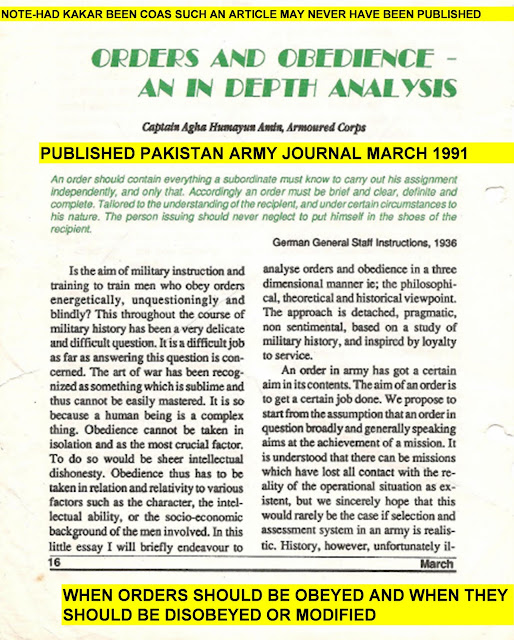
WHEN ORDERS SHOULD BE OBEYED AND WHEN DISOBEYED OR MODIFIED AS SEEN IN MILITARY HISTORY-MARCH 1991


Selection and Assessment of Commanders in Pakistan Army-Pakistan Army Journal-Citadel-Command and Staff College
These articles published in military journals of Pakistan Army endeavour to subject the highly defective system of assessment of officers to criticism despite strict censorship.
One must add that some discussion became possible in the army only after 1988 when General M.A Baig took over .
In the Zia era , with intellectual honesty buried and hypocrisy and sycophancy being hallmark of the army for 12 long years (1976-88) this was impossible.
After 1998 once Brigadier Riaz took over as DG ISPR the situation improved.
Three editors of Pakistan Army Journal were outstanding , all in succession , i.e Colonel I.D Hassan (a chronic bachelor and very cereberal and well read) , Lieutenant Colonel Syed Ishfaq Naqvi (outstanding) and Lieutenant Colonel Syed Jawaid Ahmad (soft spoken but bold as far as publishing articles and extremely knowledgeable).
In the command and staff college there was Lieutenant Colonel Ashraf Saleem (later lieutenant general) , Lieutenant Colonel Tariq Khan (now lieutenant general) and Lieutenant Colonel Ahsan Mahmood (now major general) , all three were well read and had a high intellectual calibre particularly Tariq Khan.
After these three the pedants came and pedants and the conformists off course are in preponderance !
I would say the assessments that I made in faulty and fallacious assessment of military commanders continue !
If Tariq Khan became a three star it was a triumph of destiny over a thoroughly rotten system !
But then we must remember that Moses survived in Pharohs palace and finally overcame the Pharoah !
This unfortunate country Pakistan needs a Moses , a man who purges this rotten country !
If not , then I dont have the least doubt that Pakistan will be destroyed ! It will cease to exist as a country ! This is my conviction !
This country Pakistan has no soft solutions !
If Pakistan has to survive it will have to go through night and blood ! And the blood of the elite !
WHEN ORDERS SHOULD BE OBEYED AND WHEN DISOBEYED OR MODIFIED AS SEEN IN MILITARY HISTORY-MARCH 1991
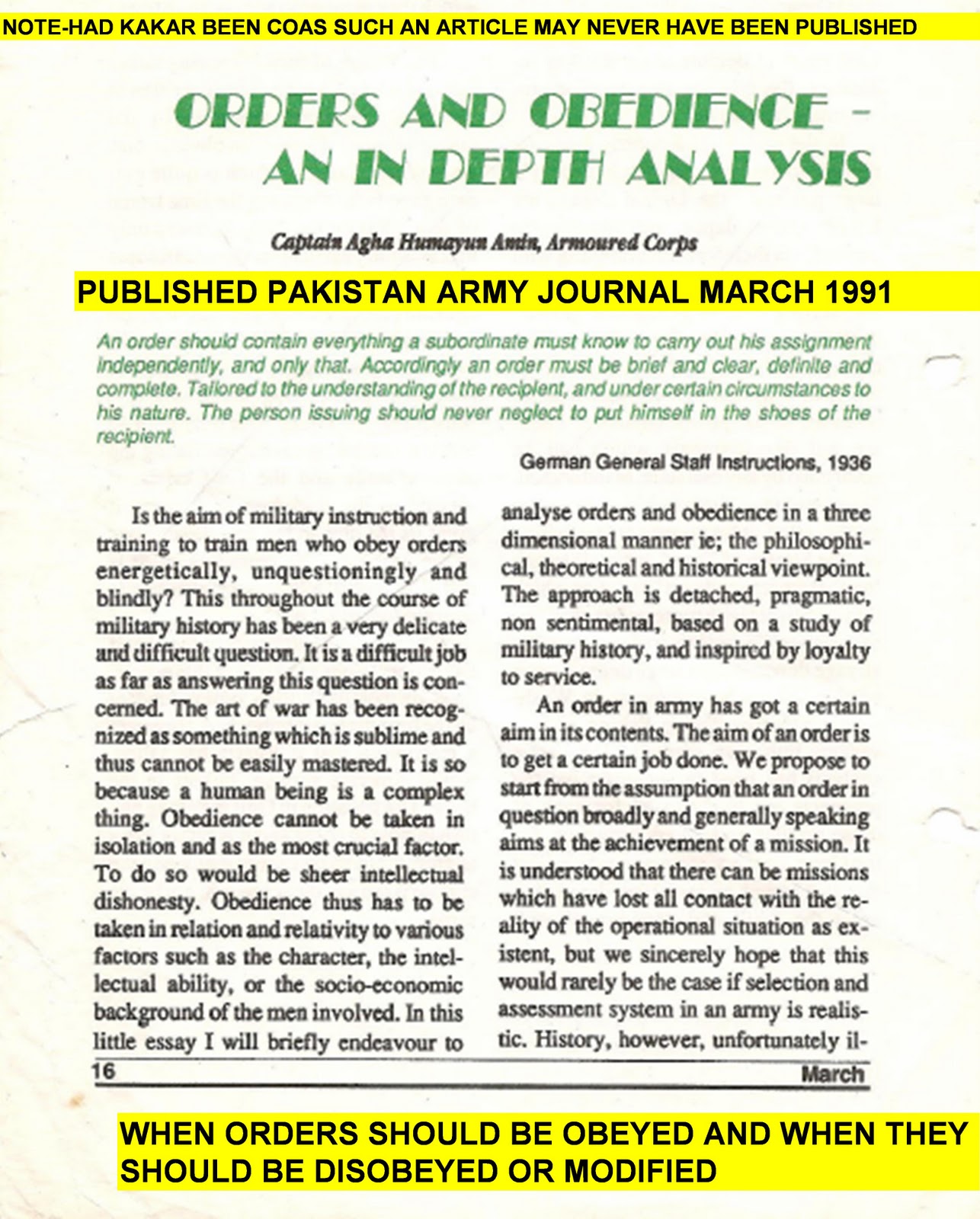
On the first page a question is raised " if selection and assessment system in an army is realistic" .
There was a big question mark in 1991 when I wrote this , it remained when I retired in December 1993 because the army then was run on whims and likes and dislikes and no one bothered how good an officer was in real command and intellectual ability ! I fear that the large gaps and question marks remain to date ? The very Kargil operation proves that an overambitious man with myopic strategic vision like Musharraf can rise to the highest ranks ,shamelessly abandons bodies of soldiers and then proclaim Kargil as his greatest success ! One could see an ambitious man in him in 1993 , who was obsessed with self projection ! I had asked Lieuenant Colonel Ashraf (then CO 46 Field and my platoon commander in PMA , also GSO 1 , 14 Division what he thought of Musharraf his brother gunner officer .Ashraf an outstandingly honest and straight man hailing from Kalar Saidan near Pindi stated " what can you make of a man who uses generator of his locating unit for his house "
No one in kargil had the courage to point out that the operation was a wild gamble ! Brigadier Simon confided that that General Tauqir Zia was against it but then Tauqir Zia never gave his dissent ?
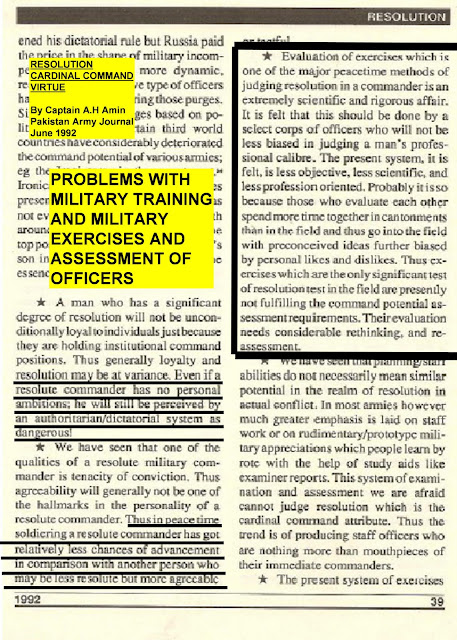
PROBLEM WITH MILITARY TRAINING , MILITARY EXERCISES AND ASSESSMENT OF OFFICERS

A real soldier in the peacteime environment of jee hazoori and yes man ship hardly has any chance of being promoted ! True in 1992 when I wrote this and true today ! Can Pakistan afford t
Related Video
-
Hadisa - 29th March 2013 On CNBC Pakistan Full Cri...
-
Istehkam e Pakistan Conference 2010 Part3 of 5 hel...
-
Hindus in Pakistan Organized POOJA for Karachi P...
-
MAX KEISER PONZI Lottery! British BANKING organiz...
-
MAX KEISER PONZI Lottery! British BANKING organiz...
-
Youth Bulge, Public Policy, and Prospects for Peac...
-
The British Empire Wants You To Be Stupid...


Related Photo


Post a Comment