
The 1971 War in West Pakistan-A Strategic and Operational Analysis
The Western Theatre in 1971
A Strategic and Operational Analysis
A.H AMIN
January 2002
ALL MAPS ARE CONCEIVED AND DRAWN BY A.H AMIN IN JANUARY 2000 AND PUBLISHED IN JANUARY 2002 IN DEFENCE JOURNAL , KARACHI.
CLICK ON MAPS TO ENLARGE
The Western Front in 1971 War has not received the due attention that it deserved from the point of view of lessons learnt and generalship in action. The obvious reasons for this reason lie in the fact that the East Pakistan crisis was the focus of attention and the surrender a Dacca was too large an historical event!
The war on the Western Front is an invaluable study in terms of strategy, operational leadership and battle tactics. The future reorganisation of Pakistan and Indian Army was done based on the experiences of 1971.Historical BackgroundThe 1965 War produced a major change in both Indo-Pak armies.
In Pakistan Army the two key lessons derived from 1965 War were to have more infantry and to have intermediate higher commands between units and brigades based on the corps rather than the division command concept.
Till 1965 Pakistani GHQ had naively hoped that division headquarter was a suitable level of operation command.
Thus in 1965 Pakistan Army had just one corps headquarter and all other formations were divisional headquarters which functioned under higher command of the GHQ.This concept of organisation had broken down in Khem Karn where the main Pakistani attack of the war was launched.
Further there had been lack of cooperation between the armoured and infantry division in this battle since no higher corps headquarter was controlling both the divisions and the infantry and armoured division commander had a personality clash.
The Pakistani GHQ now firmly decided to iron out these contradictions and created three more corps headquarters i.e Headquarter 2 Corps to control/coordinate Pakistan’s 1st Armoured Division and its sister infantry formation, Headquarter 4 Corps to control operations of the 10 and 11 Division in the Ravi-Sutlej Corridor and Eastern Command to command the troops stationed in East Pakistan.
Organisationally the Pakistan Army was now on a sound footing, but this process was soon derailed since political developments, threw the entire post-1965 reorganisation to winds. Developments in East Pakistan in 1971 forced the Pakistani GHQ to move its strategic reserves i.e 9 and 16 Divisions to East Pakistan.These divisions had been raised in 1966-68 soon after 1965 War.
This necessitated the raising of two more divisions to take the place of the reserve divisions sent to East Pakistan i.e the 33 and 37 Divisions.
The 23 Division was raised at Jhelum in June-July 1971 to look after the Chamb-Dewa area thus reducing the 12 Division of the burden of looking after a 200 mile plus area of responsibility.18 Division was raised at Hyderabad to look after the 560 mile stretch between Rahimyar Khan and Rann of Katch.
The Indians also drew significant lessons from 1965 War and increased the number of formations protecting their line of communication between Pathankot and Jammu and in giving greater importance to the hitherto neglected area south of Sutlej starting from Sulaimanke. In addition the Indian High Command keeping the political developments in East Pakistan changed its 1965 Strategy of attacking West Pakistan in strength and decided to launch their major attack on East Pakistan from early 1971.
To do this Indians had to use three corps i.e 2,4 and 33 Corps. Pakistani Forces and Plans-Western TheatreTill 1965 Pakistan Army keeping in view its equipment and training was relatively superior to the Indian Army. India under Nehru was a peaceful country but the Sino-Indian Conflict of 1962 transformed the whole scenario.
Thus while Indian Army had by and large registered no major expansion since 1947 after 1962 the Indians embarked on a highly ambitious expansion programme.It was Pakistan’s good luck that in 1965 this process was at a very rudimentary stage, however by 1971 the whole strategic scenario had changed from 1965.Indian Army as it stood in 1971 was much stronger vis-a-vis Pakistan Army as compared with the situation of 1965.
Fazal Muqeem was thus not wrong when he stated that “with the almost daily expansion of the Indian Armed Forces since the 1965 war, it had become economically impossible for Pakistan to keep pace with her. The policy of matching Indian strength with even 1/3 or 1/4 in numbers had gradually gone overboard. Under these circumstances all that Pakistan could do was to avoid war with India and to strive to resolve her disputes through political and diplomatic meansâ€Â.1
The only problem with this quote is the fact that, at that time i.e. the period 1965-71 no one at the helm of affairs was ready to think so realistically and rationally!
Fazal’s wisdom is the wisdom of hindsight, expressed some two years after Pakistan Army had fought the disaster and humiliating war in its history and Pakistan was dismembered into two countries.
Major General Sahibzada Yaqub Khan took over as the army’s Chief of General Staff and thus Principal Staff Officer to the C in C soon after the 1965 war.
In words of Fazal Muqeem a sharp observer and one who was not lavish in praising anyone “planning had taken a turn for the better when Major General Yaqub Khan became the Chief of General Staffâ€Â.2
However, Muqeem adds that the army’s war plans in the post-1965 era were still vague about “what action should be taken in West Pakistan if an attack was mounted against East Pakistanâ€Â.3
The two statements somewhat contradictory prove that although planning improved Yaqub did not give a concrete answer or plan to solve Pakistan’s strategic dilemma.
Although no archives have been declassified Fazal Muqeem who had access to various highly classified documents by virtue of being secretary defence armed with semi-official mandate from the then prime minister to write a book on 1971 war states that the plan of mounting a counter-offensive from the Western Theatre centred around “a corps with an armoured division and two infantry divisions†......while “remainder of the army was to perform mainly a holding roleâ€Â.
The most significant aspect of the army’s main plan of attack i.e when to launch the attack as per the then Chief of General Staff of the Pakistan Army,General Gul Hassan Khan was left undecided.5 Muqeem states that “There appears to have been a heated discussion on the timing of launching a counter-offensiveâ€Â.
There were two schools of thought here i.e one who favoured an immediate counter-offensive in relation to any Indian invasion of East Pakistan while the second a procrastinating one maintained that counter offensive should commence only after completion of preliminary operations to fix and divert the attention of the enemy.6
PAKISTANI WAR PLAN IN THE WESTERN THEATRE
Pakistani plan in the Western Front was as following:â€â€
Preliminary/Fixing Operations:â€â€
a. 12 Infantry Division at Opposite Poonch.
The aim was to force the Indians to reinforce Poonch thus weakening their other formations in 15 Corps and 1 Corps areas of responsibility,thus improving chances of success of 23 Division in Chamb and a possible counter attack by 6 Armoured Division in Shakargarh-Sialkot area.
b. 23 Infantry Division in Chamb Sector.
Not allowing the Indians to exploit a jumping area opposite Pakistan’s soft underbelly and crucial North-South line of communications passing via Gujrat.
This division was allotted two additional infantry brigades (111 and 66) an independent armoured brigade(2 Armoured Brigade) for the task.111 Brigade was a reserve brigade while 66 Brigade originally belonged to 17 Division.
c. 18 Division Opposite Jaisalmer-Longanewala.
It was hypothesised that this attack would attack Indian armour southwards thus making Pakistan’s 1st Armoured Divisions task in Ganganagar area easier. Another aim of this attack was to protect the vulnerable Pakistani North-South road link which was just about 65 kilometres from the border in this area.
d. 105 Independent Infantry Brigade Group opposite Fazilka.
This was essential to ensure the safety of the most crucial Sulaimanke Headworks which was just about 1500 metres from the international boundary.
Main Attack-Counter Offensive
a. Attack with 1st Armoured Division and two infantry divisions (7 and 33) opposite Ganganagar-Anupnagar.
b. This force after crossing the Bikaner Canal (Gong Canal) opposite Bahawalnagar was to capture Bhatinda and then swing north to possibly threaten Ludhiana. Candeth the Indian C in C Western Command was of the opinion that the main objective of this Pakistani attack was to cut the road Ferozpur-Ludhiana and then isolate/eliminate Indian garrison at Ferozpur.7
The Pakistani official historian Shaukat Riza in line with the pedantic sub continental tradition of hiding what is no longer relevant even two decades after an event states nothing about aims/objectives of this grand counter offensive in his monumental “The Pakistan Army-1966-71â€Â.
Formations in Holding Role
a. 12 Division in Kashmir except in Poonch Sector.
b. 23 Division in Hill Sector North of Dewa.
c. 8 and 15 Division in Sialkot and Shakargarh Bulge.
d. 10 and 11 Division in Ravi-Sutlej Corridor.
e. 18 Division in all sectors except Reti-Ubauro.
f. Northern Area Scouts in Northern Areas.
Formations tasked for Counter Penetration or Counter attack Role:---
a. 6 Armoured Division less two armoured regiments detached to command 2 Independent Armoured Brigade Group under command 23 Division in Chamb and 17 Infantry Division less one infantry brigade detached under command 23 Division in Chamb to counter attack in Ravi-Chenab Corridor when ordered.
Both formations were under command Headquarter 1 Corps and were also army reserves.
2 Independent Armoured Brigade Headquarter was given two units of the 6 Armoured Division i.e 11 Cavalry and the newly raised 28 Cavalry.2
Independent Armoured Brigade Headquarter had been raised following a wargame held in August 1970 which had concluded that “Pakistan had insufficient reserves for a reasonable counter offensiveâ€Â.8
b. 8 Independent Armoured Brigade stationed in general area Pasrur and tasked to carry out various contingency counter-attack or counter penetration tasks when ordered by Headquarter 1 Corps.
8 Armoured Brigade had been raised based on findings of a wargame held in August 1970 by withdrawing integral armoured regiments from some infantry divisions.
c. 3rd Independent Armoured Brigade stationed in Ravi-Sutlej Corridor under command Headquarter 4 Corps was tasked with various contingency counter attack plans of counter attack/counter penetration.
15 Lancers one of the units of this brigade was assigned the responsibility of looking after the line of Sutlej River from Kasur till north of Sulaimanke.
CLICK ON MAPS TO ENLARGE
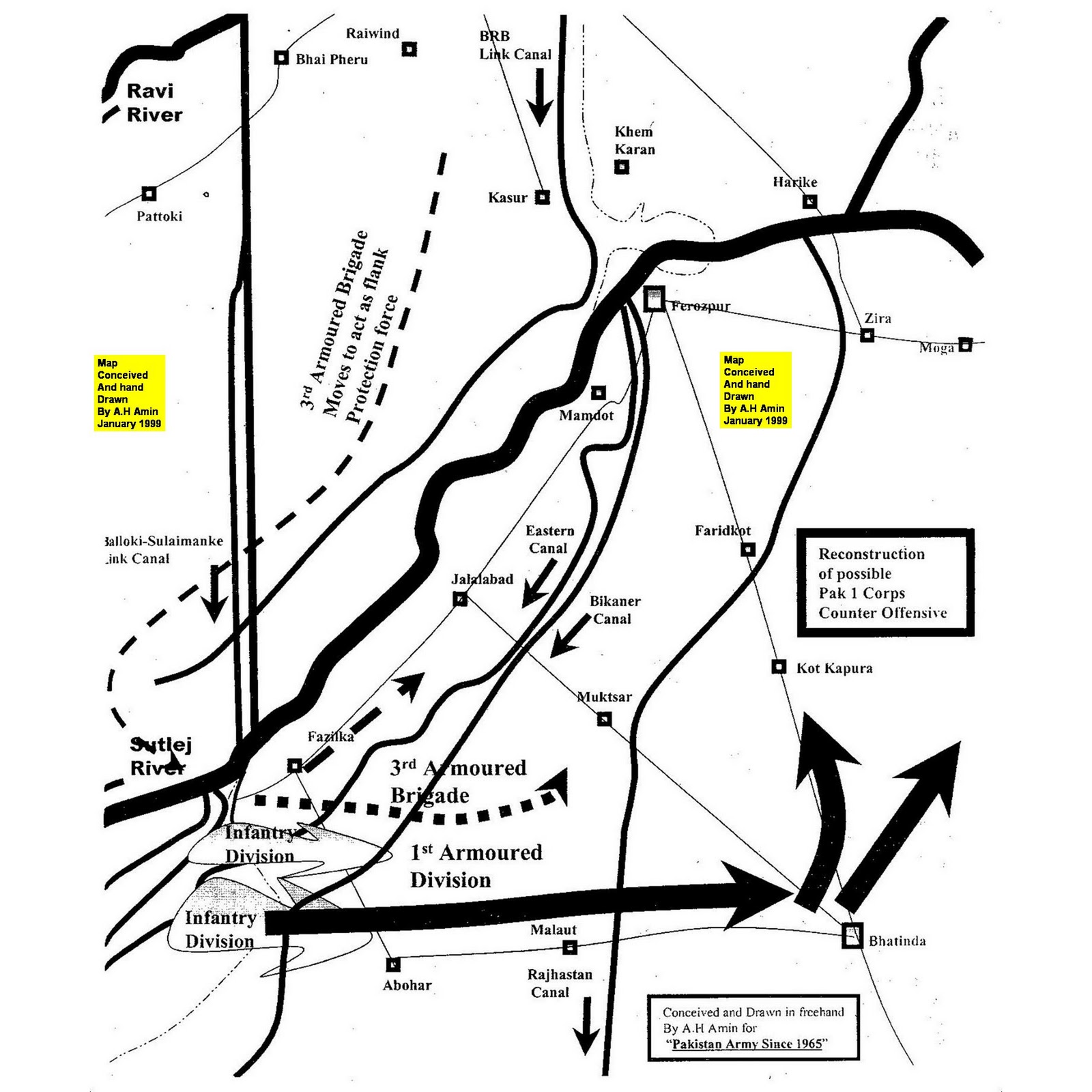
Recently in a book published in 1998 Brigadier Z.A Khan stated that this brigade was also to perform duties of flank protection with the 2 Corps counter offensive force.9
Indian Forces and Plans-Western Theatre
Indian strategy in the Western Theatre was basically to stay on the defensive while its Eastern Command conducted an all out offensive campaign aimed at reducing East Pakistan.
The prime aim in words of Gurcharan Singh Sandhu being “to prevent Pakistan from being any sizeable inroads into Indian territoryâ€Â10 while the Eastern Command was busy in the creation of Bangladesh Indian Forces
a. Western Command:â€â€
Commanded by Lieutenant General K.P Candeth consisting of 15 Corps (Lieut General Sartaj Singh) deployed in Kashmir,1 Corps (Lieut Gen K.K Singh) was tasked with the defence of the area from Aik Nala in Kashmir till and excluding Dera Baba Nanak Enclave on the Ravi River north of Amritsar and 11 Corps (Lieut Gen N.C Rawlley) holding area from Dera Baba Nanak Enclave in the North till a point on the Rajhastan border south of Anupgarh.
b. Southern Command:â€â€
Commanded by Lieut General G.G Bewoor this command was responsible for the defence of area starting from Bikanir Sector in the North till the Arabian Sea in the south.This area of responsibility of this command was divided in four sectors i.e Bikaner, Jaisalmer, Barmer and Katch. This command had two divisons i.e 12 Division in the north and 11 Division holding Barmer and Katch Sectors.In addition it was supported by an armoured regiment, two independent armoured squadrons and one missile squadron.
c. Army Reserves:â€â€
1st Armoured Division was stationed in Muktsar area against the expected Pakistani 2 Corps Counteroffensive in Ganganagar area.14 Infantry Division was stationed with Headquarters in Faridkot area.This division was also given some defensive responsibilities by Headquarter 11 Corps in Ferozpur and Fazilka Sectors.
CLICK ON MAPS TO ENLARGE

Indian plan/dispositionsWestern Command:â€â€
a. 15 Corps :â€â€
This corps consisted of five infantry divisions (3,19,25,10 and 26) and one independent armoured brigade.3rd Infantry Division was tasked to hold Ladakh Sector bordering Chinese Held Tibet and till Fortu La Pass.
Since no threat was expected in this sector one of the infantry brigades of this division was stationed at Suratgarh area.
The other two brigades of the 3rd Mountain Division were in their divisional area while the independent brigade holding Kargil Sector (Fortu La Pass to Zoji La Pass) was also placed under command 3rd Division.
The Partapur Sector opposite Shyok River Gorge was held by Ladakh Scouts.
19 Division was looking after the Kashmir Valley Sector from Zojila Pass till Hajipir Bulge in the Pir Panjal Range.
25 Division was in charge of the Rajauri Sector comprising Rajauri,Poonch and Nowshera areas.
10 Division was looking after the Hill Sub Sector and Chamb.15 Corps was given the defensive tasks in all areas except 10 Division in Chamb Sector.
10 Division was tasked to attack towards Gujrat-Tanda area based on the assumption that an offensive posture in this area was the best guarantee for the defence of Chamb. The Corps Headquarter of this corps was at Udhampur.
b. 1 Corps:â€â€
This corps consisted of three infantry divisions (36,39 and 54) and two independent armoured brigades (2 and 16).
This corps was assigned an offensive task of attacking Pakistan’s Shakargarh Bulge with a view to commit Pakistan’s 1 Corps into defensive tasks thus ensuring that Pakistan could not launch any offensive adventure in Indian territory specially against the Indian line of communication from Punjab to Kashmir i.e the Gurdaspur-Pathankot-Samba-Jammu Road.
This corps move to the area was carried out as a direct reaction to the movement of the strike elements of Pakistan’s 1 Corps i.e 6 Armoured Division and 17 Infantry Divisions into the Ravi-Chenab Corridor.
The reader may note that the Shakargarh Bulge by virtue of its close proximity to Pathankot-Samba-Jammu Road, was a great source of mental tension to the Indian High Command.11
The Indians saw the bulge as a great natural threat and 1 Corps prime task was to ensure that Pakistan’s 1 Corps could not use this bulge as a diving board to launch a lightning thrust against the Indian line of communication from Indian Punjab into Kashmir.
Thus 1 Corps was given various offensive tasks in Shakargarh like capture of Shakargarh and Zafarwal.
1 Corps was tasked to first contain any Pakistani advance in Indian territory frontally and to then deliver a riposte against Pakistani line of communications so as to force them back.12c.
11 Corps:â€â€
11 Corps consisted of three infantry divisions i.e 15 Division, 7 Division and Foxtrot Sector (ad hoc) and an independent armoured brigade (14 Armoured Brigade).
14 Armoured Brigade theoretically consisted of five armoured regiments (18 Cavalry, 62 Cavalry, 64 Cavalry, 70 Armoured Regiment, 71st Armoured Regiment,) one independent recce tank squadron and one mechanised infantry battalion.
Practically most of its units were dished out to 86 Brigade in Dera Baba Nanak Enclave ,F Sector and Mike Force and it only retained one tank regiment i.e 64 Cavalry (T-54).
The area of responsibility of the corps was from Dera Baba Nanak Enclave in the north till a point near Anupgarh in Bikaner area.
No major fighting took place in this corps area, however, the vast bulk of Indian armour units were stationed in this corps area of responsibility during the war.
15 Division (Four infantry brigades and two armoured regiments)was responsible for defence of area from Dera Baba Nanak Enclave till and including Lahore-Amritsar Road.
CLICK ON MAPS TO ENLARGE

In addition 11 Corps had a reserve brigade taken from 14 Infantry Division in Ajnala area.
7 Infantry Division (Three brigades and an armoured regiment)was responsible for axis Khalra-Lahore,Khem Karan-Kasur and Ferozpur-Kasur till and including Jalalabad South of Ferozpur.“
F Sector†(three infantry brigades and approx seven tank squadrons) was responsible for area from excluding Jalalabad till a point south of Anupgarh.
Mike Force was a reserve held by Western Command.This force consisted of 62nd Cavalry (T-55),18TH Cavalry less B Squadron (T-54), one Mechanised Infantry Company and a medium artillery regiment.Its headquarter was at Abohar and the units were located east of Ganganagar.
In addition 11 Corps had a reserve brigade taken from 14 Infantry Division in Ajnala area.
Before 1965 both sides had hardly any troops in the area south of Sutlej less Fazilka which was held by a brigade each.
After 1965 both sides constructed extensive obstacles in the entire area from Chamb till Sutlej making the area literally extremely expensive to trespass !
Thus the emphasis after 1965 shifted to area south of Sutlej River and both sides knew that any major attack would come in the area south of Sutlej.
Thus the area south of Sutlej in 11 Corps area of responsibility was accorded great importance.Thus the Foxtrot Sector backed by an armoured division to its immediate rear.
Army Reserves:â€â€
a. 1st Armoured Division: (Four Tank Regiments) .
b. 14 Division: Three infantry brigades.
c. These Indian Army Reserves stationed in 11 Corps area of responsibility.
The 11 Corps and Western Command in consonance with the tradition of bullying lower headquarters wrested two brigades (one placed at Ajnala and one to Hussainiwala) from 14 Infantry Division.
However 1st Armoured Division commander successfully resisted these attempts from both higher headquarters.13
Both these divisions were tasked to counter any attack by Pakistan’s 2 Corps in the area south of Sutlej. The Indian GHQ had positioned 1st Armoured Division at Muktsar North of Fazilka and East of Bikanir Canal thus in case the Pakistani 1 Corps attack had been launched the Pakistanis would have had a free run till the Bikanir Canal. However it appears that the Indian plan in this area was to subject any Pakistani thrust to stiff resistance on the line of Bikanir Canal.
Candeth the Indian Army Commander Western Command states that the reason for placing 1st Armoured Division North of Fazilka was to deny Pakistan’s 1st Armoured Division the opportunity to threaten Ferozpur or Ferozpur-Ludhiana Road.14
Southern Command:â€â€
The Southern Command had two divisions deployed along Pakistan’s southern border i.e the 11th and 12th Infantry Divisions.
There were four sectors in this command i.e Bikaner, Jaisalmer, Barmer and Kutch.
Fighting took place only in the Jaisalmer and Barmer Sectors while the other two sectors saw negligible activity because of absence of communications.
Indian deployment/plans were as following:â€â€
a. 12 Division:â€â€
This division was deployed in the Jaisalmer sector and was commanded by Major General Khambata with headquarters at Tanot 120 Kilometres north of Jaisalmer.
This division had three infantry brigades,a tank regiment consisting of AMX-13 tanks, an independent tank squadron (T-55) and an engineer battalion.
The division was tasked to advance on Axis Kishengarh-Rahimyarkhan towards the Pakistani communication centre Rahimyarkhan located on the main Pakistani north-south Lahore-Karachi Highway with a strength of one infantry battalion, light artillery regiment, one tank regiment (20 Lancers) and an independent tank squadron consisting of T-55 Tanks.
Another holding brigade of the same division was to launch a diversionary attack by attacking and capturing Islamgarh. The third brigade was to hold a firm base.
b. 11 Division: This division was deployed in Barmer Sector and was commanded by an armoured corps officer Major General R.D.R Anand. It was concentrated in Barmer area by October 1971.
The division had two brigades and a tank squadron(T-55). It was tasked to capture Naya Chor by advancing along axis Gadra Road-Munabao.Subsidiary attacks were to be made on Khinsar and Chacchro.
1971 War Western Theatre
12 Divsion Attack
The Pakistani plan to capture Poonch was a bold gamble undertaken with insufficient resources. The essential idea being to outflank main Indian defences at Poonch by an attack by infiltration capturing dominating features of Thanpir and Chandak to the east and rear of Poonch garrison thus threatening Indian line of communication going north to south over Poonch River thus forcing them to abandon Poonch.

The Indian garrison at Poonch consisted of an infantry brigade (93 Brigade) while 12 Division had planned to infiltrate with two infantry brigades.
The plan was sound in conception but failed because of irresolution at divisional level,loss of surprise, poor logistic arrangements and refusal of Indian brigade commander at Poonch to panic.
Surprise was lost before the operation was launched since Indian intelligence gave their higher headquarters about the impending operation.
Thus the Indians reinforced the area before war had begun (on 25 November )15 with another brigade i.e the 33 Infantry Brigade from the 39 Division of 1 Corps tasked to attack Shakargarh Bulge.
This move certainly caused imbalance to the Indian 1 Corps plans against Shakargarh but saved Poonch. Pakistan’s 2 AK Brigade and 26 Brigade were to execute the plan.
The attack initially went very smoothly and the Thanpir and Chandak Ridges were captured by Pakistan Army.
However, Danna on the deep right flank of the Pakistani infiltrating brigade was strongly defended and resisted capture.
The troops who had captured the Thanpir and Chandak Ridges were not adequately supplied.
As per Fazal Muqeem the divisional commander Major General Akbar Khan (later a candidate for post of chief in 1976) did not lead from the front “to give the required push†and “there was a lack of a necessary push and drive at brigade and battalion levelâ€Â.16
Finally the infiltrating force had to withdraw. There was no General Wolfe here to lead the infiltrating Pakistan Brigade onto the narrow path to victory.
But then Wolfe died and Quebec was captured by his troops.
At Poonch no Pakistani officer beyond colonel rank was killed and Poonch stayed in Indian hands!
It may be added that the Northern Areas were given very low priority by the Pakistani GHQ.
This enabled the Indians to capture important posts overlooking Kargil-Leh Road and in Paratpur Sector.
Later these posts became the stepping ground for Indian infiltration into Siachen.
23 Division Operations
Pakistan’s 23 Division was facing a larger division in Chamb yet it captured Chamb despite determined Indian opposition.
After this the division established a bridgehead opposite Pallanwala across the Tawi to conduct further operations against Jaurian.
The whole process came to a full stop on 10th December when Major General Eftikhar the indomitable GOC of the division was killed from injuries suffered in a helicopter crash.
At this stage the Indian 10 Division had strong reserves which were uncommitted i.e an infantry brigade which was free after capturing the Phulkean Salient and the 3rd Armoured Brigade comprising 8th Light Cavalry (Vijayanta) and Central India Horse (T-55).However in case Pakistan’s 23 Division had captured a foothold across Tawi ,these Indian reserves would have become committed.
1 Corps Operations
Pakistan’s 1 Corps was responsible for defence of Shakargarh Bulge and Sialkot.
The Shakargarh Bulge offered many jumping areas for Pakistan’s 6th Armoured Division to sever the Indian line of communication from Pathankot to Jammu.
The Pakistanis had three excellent minefields protecting the bulge apart from the Ravi River on the south and adequate reserves to launch an attack into Indian held Kashmir while the attacking Indians were caught in the three minefields.
The Pakistani GHQ was, however, already dominated by a defensive mindset and the 1 Corps Commander was one known for procrastination,indecision and vacillation.
A man of few words whose professionalism ended at checking arcs of fire of all infantry trenches of all infantry battalions holding the forward defended localities.Lieutenant General Irshad viewed his task as that of a sentry who had to react only when threatened and would do nothing else !
Thus the 6th Armoured Division remained on rear sentry duty around Pasrur and Daska while the 17 Division was deployed to defend the Marala-Ravi Link many miles in the rear and at no stage under any Indian threat.
CLICK ON MAPS TO ENLARGE

The Indian Corps Commander K.K Singh was another PHENOMENALLY HOPELESS similarly typical sub continental corps commander,mediocre in operational outlook,immensely concerned about security,timid in offensive operations.
He was the same man because of whose irresolution and poor handling of armour the Indians failed to win the 1965 War within few hours at Gadgor on 8th September!
K.K Singh had two armoured brigades and a comfortable superiority in infantry.
However he was more concerned about security just like his Pakistani counter part and had deployed half of his corps in holding roles,divided his armour, dishing it out to holding infantry formations leaving two weak armoured brigades to lead infantry division advances at infantry pace at many points.
The result in words of an Indian analyst was “patheticâ€Â......â€Âthere was total lack of offensive spirit at any levelâ€Â!17 However, by 15th December one Indian Division whose advance was spearheaded by a tank regiment had breached all three minefields! Now comes the reaction of Pakistan’s 1 Corps Commander like an NCO drilling a platoon of recruits! 8 Armoured Brigade is told to launch a counter attack to restore the situation with minimum force.
No artillery beyond the obsolete 105 MM Priest Self-Propelled Guns was used to support the attack and the result was an Indian tank regiment contained with three Pakistani Tank Regiments two of which lost almost half of their tanks!
One of the most unfortunate incidents of 1971 War was the 35 FF attack on Barapind-Jarpal.
The Indian Armoured Corps historian called it “an attack doomed to failure†and one in which “a heroic battalion was sacrificed to no purposeâ€Â!18
Even Pakistani historian Fazal Muqeem found nothing correct in this attack and thus concluded “The few counter attacks which 8 Division (Major General Abdul Ali Malik) tried during the war were noticeable by their lack of planning...The worst example of this attack was on December 17â€Â.19
The hallmark of higher commanders in both Pakistani and Indian 1 Corps was phenomenal incompetence.
The Indians captured some large size mud villages of no strategic consequence which were returned at Simla Talks.
Pakistan’s 6th Armoured Division and 17th Division remained unemployed and no effort was made by Pakistan’s 1 Corp Commander to wrest the initiative from the Indians or to make the Indian Corps Commander to his offensive moves!
Mediocrity was the common factor on both sides in 1 Corps battle. India and Pakistan are indeed unique in having phenomenally hopeless two and three stars !
The Indian 1 Corps Commander advanced because he was told to do so and the Pakistani 1 Corps Commander did not advance because no one told him to do so!
Hopeless windbag generals on both sides.
I think the situation has worsened since then and not improved.Good for both the countries.
4 Corps Battle Operations
4 Corps of Pakistan was in holding role in the Ravi Sutlej Corridor and facing about two Indian divisions with two of its own.
Certain minor actions like capture of Indian Enclave opposite Hussainiwala Headworks took place in 4 Corps operational area.
Hussainiwala was an enclave west of Sutlej and difficult to hold.
The Indian battalion 15 Punjab fought well and this was acknowledged by Fazl Muqeem20 but was betrayed by its commanding officer who had pitched his headquarter in the safety of Sutlej River on the East bank.
Most notable here was the conduct of Pakistan’s Lt Col Ghulam Hussain Chaudhry of 3rd Punjab who led his battalion from the front and was killed in action.
One of the very few commanding officers to get killed in action on the Western Front. No road in any major cantonment is named after this brave man in Pakistan!
Hussainiwala was a small affair in terms of casualties. The Indians who were well entrenched suffered a total of 19 Killed 21 casualties.
105 Independent BrigadePakistan’s 105 Brigade carried out a small scale but highly aggressive operation in Sulaimanke area opposite Indian town of Fazilka.
The strength here was in Indian favour but Indian brigade commander S.S Chowdry was highly incompetent in placing his forward battalion 10 kilometre ahead of his other two battalions.
This enabled Pakistan’s 105 Brigade to capture the Bund ahead of Sabuna Distributary thus ensuring the safety of Pakistan’s most crucial Sulaimanke Canal Headworks which was just 1,500 metres from the border.
105 Brigade’s determined counter attack severely depressed Indian Higher Commanders and 11 Corps Commander expressed a desire to abandon the area and withdraw to Fazilka Fortress and to replace 67 Brigade which was defending the area.22
Such was the state of Indian demoralisation that Western Command Army Commander finally sacked 67 Brigade Commander on 11th December.23
S.S Chowdhry was replaced by Brigadier Piara Singh. At this stage the Indian brigade commander was so demoralised that he overestimated the Pakistani strength opposite him to be two infantry brigades supported by an armoured regiment 24 while in reality the Pakistani strength on east bank of Sabuna was only an infantry battalion (6 FF) supported by a depleted tank squadron of WW Two vintage tanks.
The Indians suffered heavy casualties at Sulaimanke.Some 190 Killed, 196 Missing most of whom were killed or prisoners and 425 wounded.25
These casualties were far heavier than those suffered by 54 Division which fought battles like those around Bara Pind Jarpal which suffered a total of some 76 Killed and 272 wounded.26
Desert Sector-Rahimyarkhan-Sindh
18 Division plan to capture Longanewala was brilliant in conception. It failed because of poor logistic planning and lack of air cover.
There was hardly anything in front of the 18 Division attacking force heading for Longanewala and Jaisalmer, however, since there was no air support just two Indian Hunters neutralised Pakistani armour!
This attack has been much criticised by arm chair strategists in Pakistan.
However, the situation was saved by the fact that Indians opposing 18 Division were equally incompetent and hesitated from attacking the withdrawing Pakistani troops from Longanewala.
One positive aspect of the whole affair despite all Pakistani imperial blunders was the fact that the attack even in its failure caused such mental discomfort to Indian Higher commanders that the Indian plans to attack Rahimyar Khan were dropped.27
Thus Indian Southern Command Army Commander Lieutenant General Bewoor requested Manekshaw for a change in task with the plea that resources placed at his dispos


