
STATE Torture and ABDUCTIONS in BALOCHISTAN
COMMENT: What use are toothless and worthless conventions? —Mir Mohammad Ali Talpur

The Baloch have suffered terribly at the hands of the state since 1948 but maintain their dignity and have shown resolute courage under fire. The Baloch consider crying over the dead a sign of weakness
The Convention against Torture and Other Cruel, Inhuman or Degrading Treatment or Punishment, also known as the United Nations Convention against Torture, is an international human rights instrument aimed at preventing torture around the world. The United Nations General Assembly adopted it on December 10, 1984; it came into force on June 26, 1987. June 26 is recognised as the International Day in Support of Torture Victims. Pakistan signed it on April 17, 2008 and ratified it on June 3, 2010. It observed this day by dumping Buland Khan's tortured, bullet-riddled body in Dasht, Mastung, abducted five days before from Quetta.
The Pakistani state since signing this convention has decidedly trampled all over it in Balochistan. In 2010, 103 bodies were discovered, while 2011 saw this number rise to 203 and this year, so far, 80 bodies have been recovered. Kalat district heads the count, accounting for 133 victims; 60 bodies were discovered in Makran district and 102 victims were found in Quetta. Note: these figures are only for the past 18 months and many were victims before too, and it does not include people like Professor Saba Dashtiyari and other victims of targeted killings. No convention unless backed by sanctions is good enough to deter those who have enjoyed immunity for all past atrocities. Victims of the Frontier Corps (FC), intelligence agencies and their henchmen's brutality litter Balochistan's landscape but the Baloch persist with their struggle.
The International Convention for the Protection of All Persons from Enforced Disappearance (ICCPED) was adopted by the United Nations General Assembly on December 20, 2006 and came into force on December 23, 2010; 91 states have signed it and 32 countries have ratified or acceded it. Unsurprisingly, Pakistan remains one of the countries that refuse to sign it and even if it did, it will flout it as brazenly as it does the one on torture. August 30 is observed as the 'International Day of the Disappeared', which Pakistan observes by making even more people disappear.
This Wednesday the Senate's Functional Committee on Human Rights expressed displeasure over the increasing number of missing persons and adopted a resolution recommending the government to sign international conventions on the protection of people against forced disappearance. The Defence Secretary, Nargis Sethi, staunchly defended the intelligence agencies and stated that the whole world was hostile to the government agencies, which were doing their work in the country's best interest. Some work! She deflected the indictment of the Supreme Court about the responsibility of the FC for 85 percent of disappearances in Balochistan by stating that the FC was under the interior ministry. This lame excuse would be laughable if only the matter was not that of hundreds of Baloch being abducted and killed by the state.
The Baloch have suffered terribly at the hands of the state since 1948 but maintain their dignity and have shown resolute courage under fire. The Baloch consider crying over the dead a sign of weakness; a picture on the internet showed the mother of my students, Mohammad Khan and Mohammad Nabi Marri, flashing a victory sign by their graves. The pain she must have undergone during their disappearance and then seeing their mutilated bodies can only be known to her. In Balochi, to express the sorrow of loss of the dead, they rightly say the fire heats most the spot it burns on.
I cannot claim that I am more hurt than those who have lost their loved ones in this ongoing dirty war against the Baloch, but I too am deeply hurt and saddened because among these dead are many persons whom I knew well and was associated with during our long exile in Afghanistan. Will someone tell how one condoles and commiserates with a person who has at once lost two brothers to state brutality? Should I tell him to accept it as destiny and ask him to show forbearance? If I do that, will he not think that Ustad with age has lost his marbles? Because I would not be speaking about unknown people, strangers, but persons I knew as flesh and blood, with a passion for studying, who patiently sat hours on the gravelly ground, summer and winter, to learn the three Rs I taught them.
Each Baloch who has fallen victim to state brutality, regardless of the fact whether the interior ministry, the defence ministry or their henchmen were responsible, deserves to be thanked and remembered for their dedication and commitment to the Baloch struggle, for had they succumbed to pressures or temptations they would be alive. Among these nearly 500 Baloch who have recently paid their debt of blood to their nation, I personally knew many. But I want to especially mention my students who have died gruesome deaths at the hands of the brutal enemies of humanity, who recognise no moral or religious norms, though ostensibly they do all this in the good name of Islam.
I feel honoured and privileged to be identified with those young men, my former students, who fell participating in the fight for a life of dignity and freedom for the Baloch people. I will name them with their sub-clans sobdar: Wahid Bakhsh, Shah Mir and Ahmad Murghiani. Zaman Khan and Ahmed Ali Chalgari. Arzu, Sherbat, Murad, and Zaman Sherani. Mohammad Khan and Mohammad Nabi Pirdadani. Faiz Mohammad, Nasir and Wazir Khan Mazarani. Gulzar Taingiani and Ghulam Qadir Pirukani. Some including Dr Akbar Pirdadani are missing. They died honourably and the Baloch owe them a debt, which can be redeemed only in struggle for a just and dignified life for the Baloch. My obituary for my student Zaman Khan is at: http://www.dailytimes.com.pk/default.asp?page=2010\09\09\story_9-9-2010_pg7_19.
There will be no change in the brutality towards the Baloch even if the Convention on Protection of All Persons from Enforced Disappearance is signed by Pakistan. The brutalities will continue; for after ratifying the Convention on Torture, they mercilessly continue to torture and kill in custody. Toothless and worthless conventions will not hinder those who are bent upon subjugating people and land for exploitation. Apparently, the world too does not take these conventions seriously enough, for had these meant anything, there would have been a reaction to Pakistani atrocities in Balochistan. At present, the only thing that can and is making the essential difference is the Baloch resistance to these atrocities but that needs support from all. Those silent at atrocities on the Baloch should remember that the perpetrators will sooner or later come for them too.
The writer has an association with the Baloch rights movement going back to the early 1970s. He tweets at mmatalpur and can be contacted at mmatalpur@gmail.com
Dear All,
Please find attachments on our new initiative Torture: Asian and Global Perspectives . You are free to republish or foreword among your network.Â
With Solidarity,
Nilantha IlangamuwaÂ
PRESS RELEASE
Torture: Asian and Global Perspectives launched
The Asian Human Rights Commission wishes to inform that its new initiative, Torture: Asian and Global perspectives, was launched at an event that was jointly organized by the Asian Human Rights Commission and the Centre for Comparative and Public Law at the University of Hong Kong in the Foreign Correspondents' Club, on Monday, 25th June 2012.
Â
The bi-monthly magazine aims to extensively cover aspects of torture not only in Asia but other parts of the world as well. Its first issue was mainly focused on India, the largest democratic nation in the World. The issue presented how torture still exists in the country and how human rights activists and others who are committed to protecting human rights can campaign against these abuses with non-violence.

Torture's ubiquity in Asia is such that it has become an integral part of the continent's everyday landscape. Torture is so 'normal' that governments are rarely held to account for practicing it, judicial systems are often lackadaisical in dealing with it, national media ignore it, and the public is indifferent to it. This insidious normalisation of an abhorrent practice is a colossal bar to combating torture in Asia, Tisaranee Gunasekara, who is a Sri Lankan columnist based in Colombo pointed this out in her comment in themagazine.
Â
Meanwhile in his essay, Bob Brecher, Professor of Moral Philosophy at the University of Brighton, and author of "Torture and the Ticking Bomb", wrote an extensive analysis of torture in the present geopolitical situation. "Torture is the worst thing we do to each other. A torturous society -- the sort of society increasingly legitimized since September 2001 - is the worst society we can create; Why?"
Â
In his essay, Sheikh Showkat Hussain, a professor who teaches human rights and international law at Kashmir University, examined torture against children in Kashmir, stating that the, "Indian Constitution does not have any specific provision which explicitly provides protection against torture," he observed.
Â
Additionally, "It is not the duty of the citizen, nor is the citizen even able, to prevent torture or to create a genuine justice system. It is the singular responsibility of the state, which possesses the means and mandate to enforce the law" said Bijo Francies of the AHRC in an interview with the magazine.
Â
In our second issue we focused on Sri Lanka and tried to deliver broader coverage on torture, which is part of daily life in the island nation. In this issue many scholars contributed with their specialized areas of expertise. "The majority of torture doesn't occur for political reasons. It more often takes place in order to conduct criminal investigations so in that process, instead of properly investigating a crime and using methods of investigations through the use of forensics and other methodologies, people are just beaten and forced to confess." said Basil Fernando, an icon of human rights actives and a director of the AHRC said in an interview.
Â
In our editorial we tried to understand the problem and its root causes. One question we had was, "Why is torture endemic to the country, even after passage of many laws and the acceptance of numerous conventions against torture?" The answer might appear to be a complicated one. However, we must remember that the occurrence of torture is neither accidental nor invisible to the public.
Â
It is the result of a long and systematic process of social control, which uses old tactics of the powerful and unaccountable, without respect for past or present. Sri Lanka is unable to develop a system through which not only would torture be eliminated, but all forms of crimes would reduce, to reflect the kind of evolved civilization that we claim we are. The sad part is that these primitive practices of torture are being used as tools of social control.
Â
Even the electoral process has become cynically manipulated by those who appear to have absolute power; i.e. a site of hollow democracy where authentic dissent has little space to make its presence felt. It is perhaps naiveté on the part of the citizens that accept this space as one through which justice can be achieved and violence reduced. This acceptance has created tremendous stress and darkness in Sri Lankan society.
Â
Today we are in a situation where we must find a way to break down the system of absolute executives, as we have for absolute monarchs in the past, and hold every citizen as equal before the law. Unfortunately, today's politics ignores the principles of a free and equitable society, in favor of popularity contests between special interest factions and the compromising of the rule of law. To find a way to achieve our goals is a long term process and an understanding of voluntarism is important. "Making a path for victims to come forward and express their experiences while continuing rational discourse is crucial to any serious return to a society that respects the rule of law," Nilantha Ilangamuwa, an editor of the magazine said. He added, "Generally, politics has more in common with culture than legality. Because of this an idea of "social change" came into discourse, where social movements originated."
Â
We believed that, despite of all these facts, elimination torture is a collective process which will take a long time and tremendous effort to achieve. Torture: Asian and Global perspectives, is only one point on that long road and we hope to join hands with victims of torture and opinion makers to make our presence known to policy makers. We hope people all around the world will joined us to eliminate torture and ensure that a torture free society is possible.
EDITORIAL: Torture: Asian and Global Perspectives

Â
In releasing our first issue, Torture: Asian and Global Perspectives, we wish to convey our happiness and excitement at getting our message out to readers. We are only too aware that subjects covered in this magazine are not quite conducive to feelings of happiness. It can be depressing to talk about human rights, particularly in the face of such rampant abuse. Yet the emotion we would like to share with our readers in releasing this magazine is neither that of extreme joy nor of despair, but a quiet hope. Through bearing witness to suffering, we are determined to bring an inextinguishable light to countless victims of torture, an aspiration and ideal that individuals will no longer be denied their inherent dignity, liberties and rights. This is our response to the ever louder declamations against acts of senseless, lawless violence from persons and communities all over Asia.
Â
A free and prosperous society, however, cannot be achieved through spontaneous revolution but through the gradual evolution of public opinion and values. This can only arise from proper education and the dissemination of knowledge. To this end, our magazine will seek to address in greater detail the many different aspects of torture, a practice that persists in Asia and many other places around the world, despite a litany of prohibitive laws.
Â
Torture is often used by authoritarian regimes as a means of maintaining control and suppressing opposition. One of the reasons torture is less prevalent in some places than in others is that certain countries have open and free political processes that protect dissenting voices and institutional checks and balances to the power of any particular group. While torture is often used to address the insecurity dialogue and debate cause authoritarian regimes, there exist many historical examples societies forcing political reform despite the best efforts of whoever may be in charge. This is both a challenge and a hope for most countries in Asia today.

|
The police radio blares, "If she dies due to the torture, just report it as suicide." - Cartoon Courtesy: Clearwisdom.net (Note: Because of the 610 Office's position, function and bloody crimes in persecuting Falun Gong, the international community calls it the "Chinese Gestapo.") |
Â
CONTENTS
Â
OPINION: TORTURE: ASIA'S ELEPHANT IN THE ROOM - TISARANEE GUNASEKARA
Â
INTERVIEW: WE ARE PATHFINDERS - BIJO FRANCIS
Â
ANALYSIS: THE "TICKING BOMB": A SPURIOUS ARGUMENT FOR TORTURE - BOB BRECHER
Â
ESSAY: OF TORTURE - CESARE BECCARIA
Â
ARTICLE: TORTURE AGAINST CHILDREN IN KASHMIR - SHEIKH HUSSAIN
Â
INDONESIA: MILITARY IMPUNITY
Â
PAKISTAN: TORTURE IS A NORM
Â
VIEWPOINT: INFRINGEMENT OF TRIBS' HUMAN RIGHTS - HESHETO CHISHI
Click here to subscribe to Torture: Asian and Global Perspectives
Â
Â
The concept of publishing a bi-monthly magazine on torture was borne of these circumstances, limitations and hopes. The publication will give prominent coverage to the atrocities committed by authorities and affiliated agencies against individuals legally under their protection. We seek to create a platform for the discussion and exposure of torture practices in Asia and around the globe. Each fortnightly edition will be divided into three main types of narratives: stories from individuals of their traumatic experiences, interviews with people working in the subfield of human rights violations related to torture and feature-length essays approaching torture from specific facets of psychology, forensics, philosophy and ethics, politics and law.
Â
Our stance is firmly against any form of torture, a practice legally and morally reprehensible, and unjustifiable under all circumstances. We call for governments to investigate thoroughly and prosecute perpetrators of such brutality. We also invite our readers to participate in this campaign against torture. The global citizenry continue to hope (and should demand) that their governments, guided by the fundamental principles in the Universal Declaration of Human Rights and other international conventions, take legislative, administrative and judicial action so that not only will justice be served, but a lasting peace will be brought to humanity.
Â
The Asian Human Rights Commission (AHRC) has helped document over the years cases of torture and other human rights violations. It has become clear that individuals and peoples across Asia are frustrated and deeply embittered by the widespread lack of respect for human rights in their countries. Yet the expression of such anger and frustration tends to stay firmly in the private or domestic sphere; such is the stranglehold authorities have on individuals through the exercise of fear. This kind of discourse is difficult, if not impossible, to monitor. Despite attempts by the media to expose state-sponsored violence, it is unable to represent and broadcast the private fears, experiences and opinions of the average person. State censorship has also proved a common blight in Asia – there is often a conscious attempt by the media to reflect a positive or at least sober mood at home and expressions of domestic malcontent are quite sophisticatedly framed as unfashionably unpatriotic. Discussions about 'difficult' issues like torture are discouraged and adopt the shade of social taboos. In marginally freer forums, the media practices self-censorship in order to not invite attention, criticism and recrimination. Only an already privileged minority in society is able to express their support for the status quo. But this is a magazine to "rock the boat" and open avenues for healthy discourse.
Â
Eradicating torture is a gradual but necessary process that we all bear responsibility for. Please support us by subscribing to the print magazine so we may broaden our readership in Asia and around the world, galvanise governments and aid advocacy groups. Your help is critical for the circulation of a thing we, and the multitudes around the world, cherish and cannot easily be vanquished: hope. Let us remain steadfast in that hope we profess, of a world without violence, and a future free from fear.
Volume One-Issue Two
EDITORIAL: SRI LANKA: What went wrong?
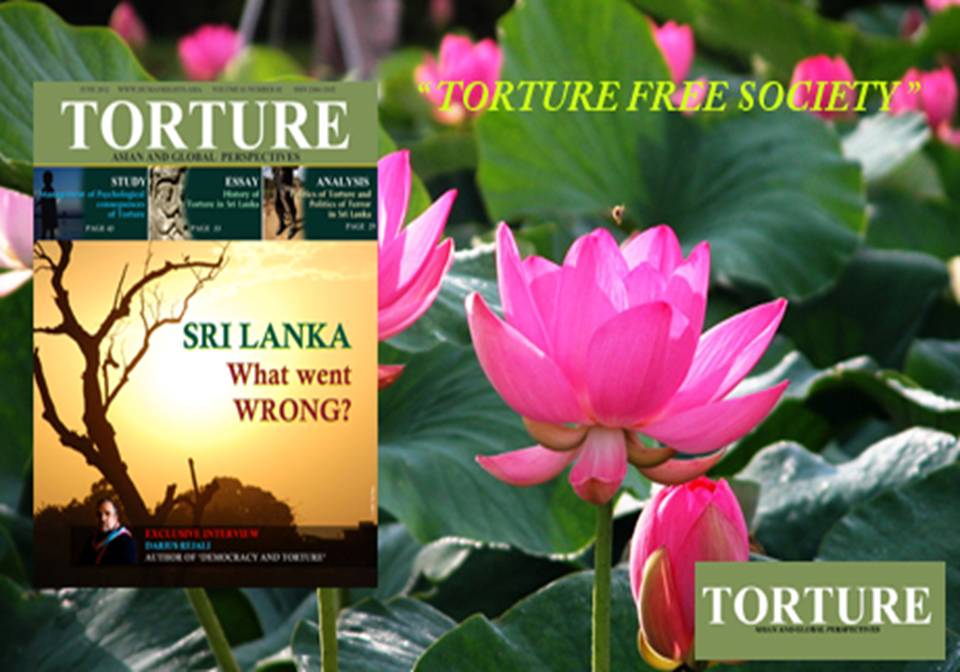
Torture is a crime. And, this criminal activity, in all its cruel, inhuman, and degrading reality has been increasing in Sri Lanka. This is so, even after the end of the civil war between the State and the Liberation Tigers of Tamil Eelam (LTTE).
Â
There is evidence that various forms of torture existed in the history of the island nation. During the long periods of 'Royal Absolute', torture was a tactic used by the authorities to impose and maintain order. In fact, a whopping 32 types of torture methods were used categorically to punish suspects in front of the public. As one of our contributors has presented here, these torture methods included being trampled by an elephant and being impaled on a pointed iron pole. The prosecution process in the country was thus rather violent and primitive until 1815, when British colonialists introduced a law against the practice of torture.
Â
In the last hundred years, many laws have been passed and many international conventions have been signed by the government on behalf of the State in acceptance of the prohibition of torture. But torture continues to be practiced widely in Sri Lanka, even today.

Illustration by Indika Dissanayake |
Â
Â
CONTENTS
Â
EDITORIAL: WHAT WENT WRONG?
Â
YOU CAN'T HAVE BAD GOVERNMENT AND TORTURE FREE SOCIETY - BASIL FERNANDO
Â
ANALYSIS: POLITICS OF TORTURE AND TERROR IN SRI LANKA -- DR. LAKSIRI FERNANDO
Â
STUDY: PSYCHOLOGICAL CONSEQUENCES OF TORTURE IN SRI LANKA -- DR. DAYA SOMASUNDARAM
Â
OPINION: UNCAT SRI LANKA EXPERIENCE -- DR. SERGEY GOLUBOK
Â
ESSAY: HISTORY OF TORTURE IN SRI LANKA -- DR. UCP PERERA
Â
VIEWPOINT: TORTURE ON SUSPECTS -- DR. THRISHANTHA NANAYAKKARA
Â
Click here to subscribe to Torture: Asian and Global Perspectives
Â
The Asian Human Rights Commission (AHRC) has documented more than a thousand cases of torture in Sri Lanka, and it has summarized over 400 police torture cases during the last couple of decades. Most police personnel in Sri Lanka remain ignorant of basic principles and ethics that they are expected to know, and required to practice, in implementing law and fulfilling duty. The consequence is merciless use of old torture practices in various new forms.
Â
Most police stations in the country have become torture chambers. Here 'suspects' get severely tortured from time to time and deaths in custody are only occasionally reported. Many citizens of Sri Lanka have become victim to these ruthless practices. To our knowledge, such torture is not limited to police stations, but is entrenched in some prisons as well.
Â
In the last week of May, 2012, the US State department issued its critical annual human rights report, which has highlighted existing methods of torture in Sri Lanka. "Former TID (Terrorism Investigation Division) detainees at Boosa Prison in Galle confirmed reports of torture methods used there. These included beatings, often with cricket bats, iron bars, or rubber hoses filled with sand; electric shock; suspending individuals by the wrists or feet in contorted positions; abrading knees across rough cement; burning with metal objects and cigarettes; genital abuse; blows to the ears; asphyxiation with plastic bags containing chili pepper mixed with gasoline; and near-drowning. Detainees reported broken bones and other serious injuries as a result of mistreatment," stated the report.
Â
There have also been frequent media reports over the last few years - about the widely practiced method of white-van abductions, which have given the public much cause for fear and anxiety. The feeling is termed 'the white van syndrome.' It has been reported from Sri Lanka that there are genuine concerns that it is the government that has been involved in some of the abductions.
Â
The widow of one such abductee has revealed details of her experience, which confirm the prevalence of brutal torture in the country. The case, in summary, goes like this:
Â
Mr. Mohamed Sali Mohamed Niyas, also known as "LokuSeeya", was abducted in a Colombo suburb by an armed gang in a white van, and then taken to an unknown location in the Eastern province, where it is believed he was tortured, killed, and his body dumped into the sea. An apt question is how such an abduction can occur, considering that it involves taking a victim hundred kilometers away from the site of abduction and that the abducting gang would have had to go through at least 5 major security checkpoints. According to the postmortem, LokuSeeya was strangled and his throat slit. Injuries show that he was pounded and pummeled on the head and stabbed a number of times. He was also administered 3 injections of unknown chemicals. His body was found strapped with over 100 kg of weight and bound with barbed wire. That is not all. The body was further covered with polythene and bound some more with chicken fencing (similar to barbed wire). There also appeared to be something like an anchor attached to the body. In spite of all this weight, LokuSeeya's body washed ashore at Akkaraipaththu. From here, it was flown back home for funeral proceedings.
Â
A question: why is torture endemic to the country, even after passage of many laws and the acceptance of numerous conventions against torture? The answer might appear to be a complicated one. However, we must remember that the occurrence of torture is neither accidental nor invisible to the public. It is the result of a long systematic process of social control, which uses old tactics of the powerful and unaccountable, without respect for past or present.
Â
Sri Lanka is unable to develop a system through which not only would torture be eliminated, but all forms of crimes would reduce, to reflect the kind of evolved civilization that we claim we are. The sad part is that these primitive practices of torture are being used as tools of social control. Even the electoral process has become cynical manipulation by those who appear to have absolute power; i.e. a site of hollow democracy where authentic dissent has little space to make its presence felt. It is perhaps naiveté on the part of the citizens that accept this space as one through which justice can be achieved and violence reduced. This acceptance has created tremendous stress and darkness in Sri Lankan society. What is being witnessed today in Sri Lanka is the collapse of basic institutions and citizens are forced to accept no-system as a system.
Â
The incumbent regime has been using cultural emotions to gain more power while sidelining the laws. Cultural dominance is a good way of understanding people's rights towards facilitating their own freedom. In the past, the royal absolute created huge distance between culture and the law. This was followed by a period that saw an overlap of cultural power with absolute power, resulting in isolation of the law. And, now, the gap between the highest practitioner of the law and the authority taken in the name of that law is itself the very foundation of dictatorship. To most citizens, the law was a stranger and did not directly cause any harm. But, those who have been allowed to abuse power in the name of law, have became the root cause of so many problems in our society.
Â
Unlike most other countries, Sri Lanka has witnessed systematic and active elimination of dissent. This began occurring when a law, claimed to be of superior value, was introduced into society. This significant and horrendous event began with the introduction of new constitution in 1978, which made the executive presidential system official. It is unfortunate that there were no statesmen at the time willing to abolish this unquestionable, unethical, and irresponsible system. Today, there are in fact many who are gaining more powers by tom-tomming the benefits of the same. And, even more harmful than this act of sheer political vandalism is the September 2010 amendment, i.e. the 18th amendment to the Constitution. It has damaged hope for political reform, essential to reconstruct any broken system.
Â
We have been going wrong in the last few decades; many political proposals have reached the legal level with lots of loopholes that have only aided the escape of the real culprits. Destruction of policing did not happen through isolated incidents, but collective efforts of the absolute power for many years. We cannot blame police officers for their becoming tools of the custodians of power in order to earn their living. In other words, destruction of morality and of the genuine policing system is not the actual disease but only a symptom. The solution or the process to find a solution needs to start at the root. Without deep feeling for, and/or genuine commitment to high level of justice, claims of reform in state institutions are a farce.
Â
What is visible before us today is only our own fallacious rhetoric:
Â
"It would not be the same here; here such things are impossible."
Â
Â
Â
Torture: Asian and Global Perspectives –
 A comment from an editor
by Eric Bailey
Â
I was amazed at how quickly the pieces of Torture: Asian and Global Perspectives fell into place, turning an idea for a magazine into a quality, finished product. When NilanthaIlangamuwa, whom I'd previously worked with at the Sri Lanka Guardian, asked me to launch a magazine with him for the Asian Human Rights Commission, I knew I had to be a part of this project. Soon I was seeing articles and interviews from some familiar and well respected names and I knew this had the potential to be something great. Now on June 26th, the 14th annual International Day in Support of Victims of Torture, we're finally ready to share our work with the world.
Â
The principle behind this magazine and the general opposition to torture isn't rooted in the idea that inflicting or prolonging pain on another person is morally wrong. That's innately understood by nearly all people. It's why you don't kick a dog and why the kind animal owner will put down a creature that is suffering, rather than leave it in pain. No, there is a greater cause at the heart of opposing torture. That cause is liberty, the fundamental moral principle that no man may have total and unconditional control of another, that no man should be made to submit to being put in jeopardy of life or limb without due process of law, and that the individual has certain natural born rights that any just law must respect, which include the rights to life and property. It is towards the protection and expansion of liberty - for every member of every class of every society – that we must dedicate our efforts.
Â
I was especially thrilled to work on the June issue, which covered human rights abuses in post-war Sri Lanka. It was during the Sri Lankan Civil War that Nilantha and I met and started working together to cover the conflict. That experience gave Sri Lanka a special place in my heart and has made the continuation of human rights abuses by a consolidated central government a subject of particular importance to me.
Â
In this issue, Torture: Asian and Global Perspectives took an in depth look into Sri Lanka's relationship with torture. Dr. UCP Perera's essay on the history of torture in Sri Lanka really helped to establish the context in which to judge the current state of affairs and demonstrated that torture on the island wasn't born from the Civil War, but has been a moral issue that the Sri Lankan civilization has been battling throughout its existence. This historical context finely complemented Dr. Laksiri Fernando's analysis of the modern use of torture and terror in Sri Lanka to maintain or gain political power.
Â
Dr. DayaSomasundaram's academic study of the psychological consequences of torture and various available coping methods illustrated another side of torture, beyond the immediate act, or the politics and other motivations behind it, as well as cataloged what specific kinds of torture tend to occur in Sri Lanka. In the study, Dr. Somasundaram also pointed out one fact that is of particular importance in my mind: that, despite the continued instances of torture, abduction, and extrajudicial killings, the actual rate of human rights abuses has greatly declined with the end of the war. It's easy to read about human rights abuses in a country and get the impression that things are as rotten as could ever be the case, but it's important to know the truth of the matter – not to excuse current trespasses, but to understand them in their proper context.
Â
I was also pleased when I learned that Basil Fernando, the AHRC's Director of Policy and Programs, and a long-time contributor at the Sri Lanka Guardian, would be interviewed for this issue. In that interview, he provided important insights into the fundamental link between torture in a country and the lack of relatively free and transparent government. The necessity of having a strictly limited government and the natural curtailing effects this has on human rights abuses is the sort of big picture point I hope all our readers will take away from this magazine.
Click here to subscribe to Torture: Asian and Global Perspectives
Â
Â
About the author: Eric Bailey is a member of the editorial board of, Torture: Asian and Global Perspectives
Â
 Tag:
Tag: Related Video
-
CRAZY LABEL, Organized Crime's Set Up To Torture A...
-
13-Year-Old Mexican Drug Cartel Hitman Found Dead ...
-
Youth Kidnapped & tortured,maimed by Beggar Mafia ...
-
GA Big Business Sponsor's Torture & Attempts of Mu...
-
Victims of Maoist Witch-Hunt Detained and Tortured...
-
Duplessis Orphans: Untold truth - Thousands of tor...
-
Chinese Lawyer Tells of Bo Xilai's Torture Methods...


Related Photo
-
BASIC TORTURE PROCESS at Guttural Gore Grind Mafia...
-
BASIC TORTURE PROCESS at Guttural Gore Grind Mafia...
-
BASIC TORTURE PROCESS at Guttural Gore Grind Mafia...
-
BASIC TORTURE PROCESS at Guttural Gore Grind Mafia...
-
BASIC TORTURE PROCESS at Guttural Gore Grind Mafia...
-
Alès, le 31 mai 2014...
-
Mafia Queen...


Post a Comment