
_Badge.png/250px-11_Cavalry_(Frontier_Force)_Badge.png)
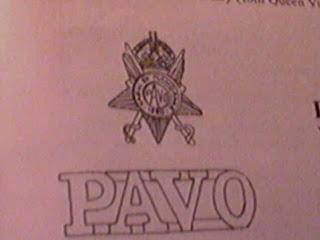






PAVO 11 CAVALRY
Lieutenant Prendergast and Lieutenant Daly who raised 1st and 3rd Punjab Cavalry on 18 May 1849.Both regiments later combined in 1921 reorganisation and were designated as PAVO 11 Cavalry




 Â
Â




Re-numbered as 21st Punjab Cavalry in 1901


Lieutenant Prendergast Bombay Army

Lieutenant Daly

 Â
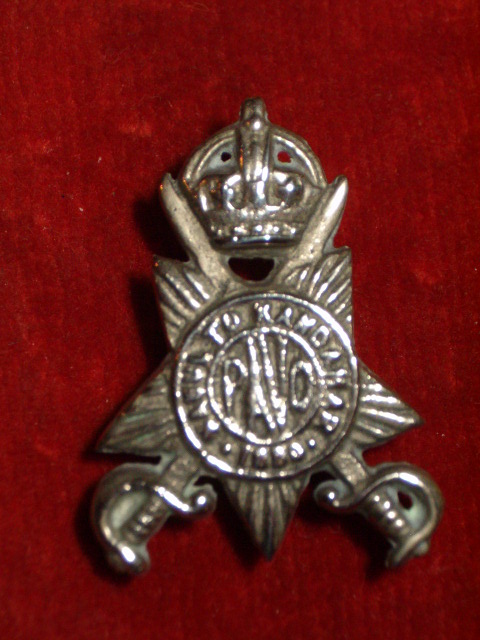
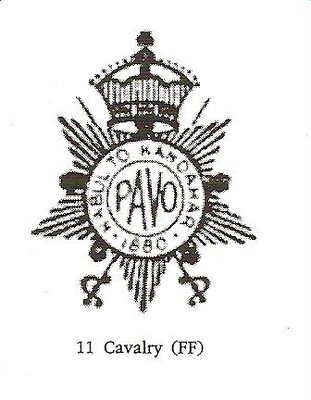
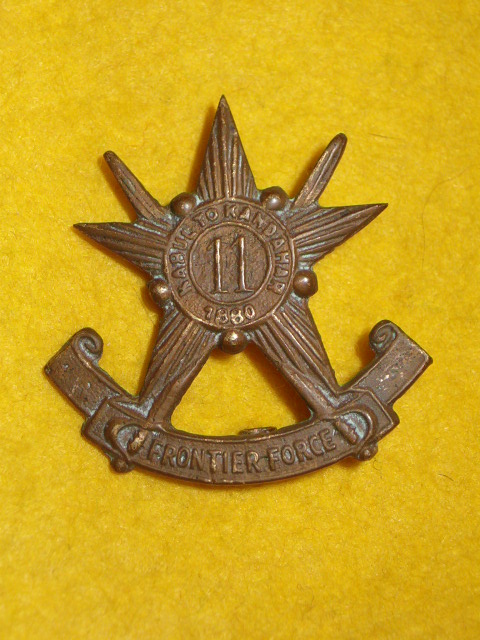
 Badge of 11 Cavalry till 1974.The Tilla badge was removed by Ayub Khan and the regiment forced to wear this metallic badge till 1974
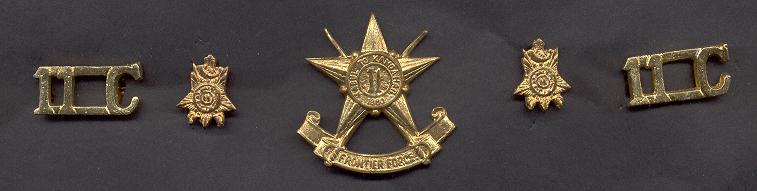

Tilla Badge that was allowed to be re-worn to the regiment by Mr ZA Bhutto in 1974


Sardar Ayub Khan brother of Afghnaistans king who defeated the British at Maiwand.11 Cavalry was part of the Britsih force that defeated him later at Battle of Kandahar.He later sought exile in British India and his descendants joined 11 Cavalry
11TH PRINCE ALBERT VICTOR'S OWN CAVALRY (FRONTIER FORCE)
From Wikipedia, the free encyclopedia
| 11th PAVO Cavalry (Frontier Force) | |
|---|---|
 | |
| Active | 1849 - Present |
| Country |   British India  British India  Pakistan  Pakistan |
| Branch | Army |
| Type | Armoured Regiment |
| Size | Regiment |
| Nickname | PAVO Cavalry |
| Engagements | North West Frontier of India Indian Mutiny of 1857 Second Afghan War 1878-80 First World War 1914-18 Third Afghan War Second World War 1939-45 Indo-Pakistani War of 1947 Indo-Pakistani War of 1965 Indo-Pakistani War of 1971 |
| Commanders | |
| Ceremonial chief | Prince Albert Victor |
| Notable commanders | General Sir Henry Daly General Sir John Watson, VC Field Marshal Sir Charles Egerton General Rt Hon Lord Ismay Lt Gen Sahabzada Yaqub Khan General Khalid Mahmud Arif |
The 11th Cavalry (Frontier Force) also known as PAVO Cavalry, is an armoured regiment of the Pakistan Army. It was previously known as the 11th Prince Albert Victor's Own Cavalry (Frontier Force) and was a regular cavalry regiment of the old British Indian Army. It was formed in 1921 by the amalgamation of the 21st Prince Albert Victor's Own Cavalry (Frontier Force) and the 23rd Cavalry.[1]
CONTENTSÂ [hide] |
[EDIT]21ST PRINCE ALBERT VICTOR'S OWN CAVALRY (FRONTIER FORCE) (DALY'S HORSE)
The 21st Prince Albert Victor's Own Cavalry (Frontier Force) (Daly's Horse) was raised as the 1st Punjab Irregular Cavalry by Lieutenant Henry Daly at Peshawar on 18 May 1849. It was one of five regiments of Punjab Cavalry raised to guard the North West Frontier of India, which soon became famous as part of the legendaryPunjab Frontier Force or the Piffers. Over the next decades, the regiment saw extensive service on the Frontier. During the Indian Mutiny of 1857-58, the regiment operated in North India and took part in the Siege of Delhiand the Relief of Lucknow, where Lieutenant John Watsonwon the Victoria Cross. During the Second Afghan War of 1878-80, it formed part of Kandahar Field Force and fought in the Battle of Ahmad Khel. In 1890, Prince Albert Victor, the Crown Prince of Britain was gazetted as their Colonel-in-Chief, giving his name to the regiment, which has endured to this day. During the First World War, the regiment served in the Mesopotamian Campaign as part of 6th Indian Cavalry Brigade. It fought on the Tigris Front and took part in the capture of Kut al Amara and Baghdad. It also fought in the Actions of Istabulat, Ramadi, Daur and Tikrit. Later it saw service in Kurdistan and took part in the capture of Kirkuk.[1][2]
- 1849 1st Punjab Irregular Cavalry
- 1851 1st Regiment of Cavalry, Punjab Irregular Force
- 1865 1st Regiment of Cavalry, Punjab Frontier Force
- 1890 1st (Prince Albert Victor's Own) Regiment of Cavalry, Punjab Frontier Force
- 1901 1st (Prince Albert Victor's Own) Punjab Cavalry
- 1903 21st Prince Albert Victor's Own Cavalry (Frontier Force)
- 1904 21st Prince Albert Victor's Own Cavalry (Frontier Force) (Daly's Horse)
_Punjab_Cavalry_1900.jpg)
[EDIT]23RD CAVALRY (FRONTIER FORCE)
The 23rd Cavalry was raised as the 3rd Punjab Irregular Cavalryby Lieutenant WG Prendergast at Lahore in 1849, and it too saw extensive service on the Frontier with the Punjab Frontier Force. During the Second Afghan War, it took part in Lord Roberts' famous march from Kabul to Kandahar as part of the Kabul Field Force and fought in the Battle of Kandahar. During the First World War, the regiment served in Mesopotamia as part of the 11th Indian Cavalry Brigade and was part of General Townsend's failed advance towards Baghdad. It then served on the Tigris Front. Later on, it moved to the Euphrates Front and fought in the Battles of Khan Baghdadi and Sharqat. One of its squadron served in PersianArabistan. On their return to Indian they saw service in the Third Afghan War of 1919.[1][2]
- 1849 3rd Punjab Irregular Cavalry
- 1851 3rd Regiment of Cavalry, Punjab Irregular Force
- 1865 3rd Regiment of Cavalry, Punjab Frontier Force
- 1901 3rd Punjab Cavalry
- 1903 23rd Cavalry (Frontier Force)
[EDIT]11TH PRINCE ALBERT VICTOR'S OWN CAVALRY (FRONTIER FORCE)
After the First World War, the number of Indian cavalry regiments was reduced from thirty-nine to twenty-one. However, instead of disbanding the surplus units, it was decided to amalgamate them in pairs. This resulted in renumbering and renaming of the entire cavalry line. The 21st and 23rd Cavalry were amalgamated in 1921 to form 11th Prince Albert Victor's Own Cavalry (Frontier Force). The uniform of PAVO Cavalry was blue with scarlet facings. The new regiment's badge consisted of the Kandahar Star representing the five rivers of the Punjab. Its class composition was one squadron each of Punjabi Muslims, Sikhs and Dogras. The regiment was mechanised in 1940. During the Second World War, it initially served in Syria and Iran, and then went on to North Africa, where it fought in the Battle of Gazala. It then moved to Burma, where it greatly distinguished itself against the Japanese. In 1946, the regiment was sent to theDutch East Indies (Indonesia) to pacify the country after the surrender of the Japanese.[1][3]
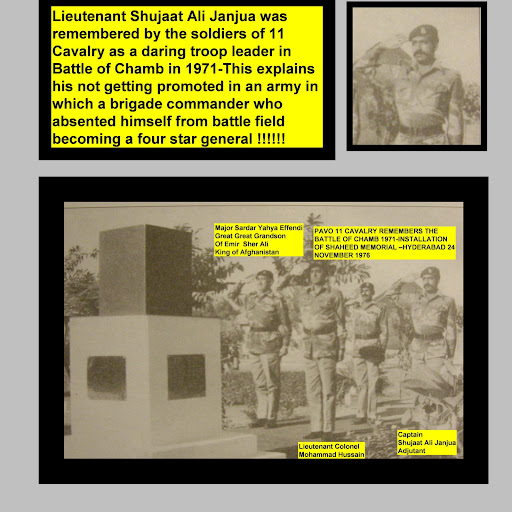
On Partition of India in 1947, PAVO Cavalry was allotted to Pakistan. The regiment was soon engaged in fighting the Indians in Kashmir. In 1956, Pakistan became a republic and all titles pertaining to British royalty were dropped. The regiment's new designation was 11th Cavalry (Frontier Force). During the Indo-Pakistani War of 1965, 11th Cavalry took part in Pakistan Army's advance towards Akhnur in Kashmir. It then fought in the Battle of Chawinda. In 1971, the regiment again served in the Chhamb Sector of Kashmir. It is the only armoured regiment of Pakistan Army to carryBattle Honours on its Regimental Colours for all three wars fought with India.[1]
-->
,_1908_(c)._Mrs_Williamson..jpg) Tag:
Tag: Related Video
-
Mexico president vows to reform police, battle org...
-
Mexico President Vows to Reform Police, Battle Org...
-
Yakuza 4 - Official Battle Trailer...
-
PS3 Rewind : Dark-Mafia Classic : Photoshoot Prior...
-
Fifa cannot combat organized crime in match-fixing...
-
Fifa cannot combat organized crime in match-fixing...
-
Cortez Speaks On Tech 9 Battle And Issues With Dot...


Related Photo


Post a Comment