
Church of 40 Thousand Muslim Bones on Order of Pope
Following was forwarded to me by an acquaintance. At the bottom is my response.
|


ÂÂ
ÂÂ
January 06, 2009
ÂÂ
Dear Sir;
ÂÂ
Thanks for forwarding interesting pictures. The story attached with these pictures does not make any historical or geographical sense. I have interest is Crusade period and a while ago I did some research including visit to holy lands. I also contacted the curator of the church who told me that there are many stories about the church (and one can  understand in view of its peculiar nature) but none of them are true. The summary of my quick review as below;
ÂÂ
Present day Czech republic is in the middle of Europe which borders with Slovakia, Poland, Germany and Austria. In hundreds of miles around Czech republic there were no known Muslim communities throughout middle ages. In year 1218, pope was Pope Honorius III (1216-1227). He was busy trying to unite kings and princes of Europe engaged in wars. In this time period only two significant expeditions from Christian kingdoms against Muslims were launched. One was led by Andrew II of Hungary which captured some coastal areas of Egypt including Damietta and other small scale expedition against Muslim ruled states in Spain. Both were relatively minor expeditions with no large scale battles.ÂÂ
ÂÂ
Second suggestion is that somehow these bones were brought from some other area. In eleventh century big crusade battles were fought around Palestine but by thirteenth century Muslims have reconquered these lands therefore no possibility of bringing bones from these lands. Reconquest of Spain was completed in late fifteenth century. Spanish inquisition on large scale started around 1478 and large number of Muslims and Jews were killed and many forcibly converted. There is no historical evidence of transfer of remains from Spain to any other area.ÂÂ
ÂÂ
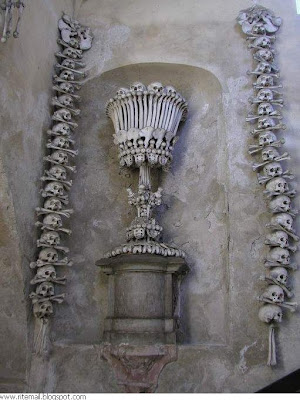
Lets now come to the story of the church.  In twelfth century a small monastery was founded in present area. The abbot of Sedelic was sent on a diplomatic mission to Jerusalem. He brought some earth from Golgotha (according to Christian belief Jesus was crucified on this rock and is now part of church of Holy Sepulcher) and sprinkled over the cemetery. In view of reverence for Golgotha, the cemetery became the most desired place for burial not only in surrounding area but throughout central Europe. Well to do people desired to be buried in this cemetery making it a relatively large cemetery compared to others. Two major events of 14th & 15th centuries brought huge numbers of new residents to the cemetery. First was bubonic plague which decimated populations of major cities of Europe including present day Czech republic. In 1318 about 30,000 people were buried in the cemetery. Second event was Hussite wars fought in the region resulting in large number of deaths. Church was built in early 15th century. Arrangement of bones in the church was done in 1870 by a wood carver. The church's ossuary (many churches have ossuaries and are used where burial space is scarce. A body is first buried in a temporary grave, then after some years the skeletal remains are removed and placed in an ossuary) contains the remains of about 40 000 people.  By all accounts these mortal remains are of Christians.
One can understand anger and frustration among Muslims. We all have blood on our hands regardless of our religion, sect, nationality or ethnicity. There are plenty of people on all sides adding their share on the fire of hatred. Few good men (and women) are needed to put their share to extinguish this fire. ÂÂ
'All barbarous histories have fabulous beginnings'.    Vico
ÂÂ
ÂÂ
Warm Regards,
Hamid
ÂÂ
--
Man would indeed be in a poor way if he had to be restrained by fear of punishment and hope of reward after death."  --
Albert Einstein !!!


Comments